
The Precarious Line | The Door, Where Safety and Fear Cross
This series · Ward Off, Call Forth · No. 2 (4 episodes total) Ongoing
"Ward off what's bad, call forth what's good."
- No. 1 The Brain That Invented Ghosts
- No. 2 The Precarious Line | The Door, Where Safety and Fear Cross
- No. 3 Yogwe, Dokkaebi, and Chiyu, the Heavenly King
- No. 4 Barriers Laid on Every Side, and the Byeoksa of Today
Originally written in Korean by the author. Translated with the help of AI. Read the original
You are free to quote and excerpt posts and records from the Pyeongmok blog, as long as you credit the source (pyeongmok.com).
In Part 1, we saw that humans, unable to bear misfortune without a reason, invented ghosts — and to hold them back, drew a line dividing inside from outside.
That was the beginning of the door. But this raises an odd question.
Why don't ghosts just come in through the wall?
A being said to have no physical form, unable to pass through a single earthen wall and forced to come specifically to the door — when you think about it, that doesn't quite add up. And yet, across both East and West, the evil beings of folklore seem to have made a pact to come and go only through doors and changho. Dracula cannot cross a threshold uninvited, and our own virgin ghosts linger outside the bedroom door. The answer isn't in the ghost — it's in the human mind. Because even fear needs rules.
If an evil spirit could enter from anywhere at all — through the wall, the roof, the floor — a person could never feel safe, not even for a moment. A fear with no boundary on any side is a fear you simply cannot deal with. So the human mind imposed a rule even on the unseen: "You, too, must come and go through the door, like us." The moment the route of invasion narrows to a single door, what needs defending becomes clear, and the fear moves back into territory that can be controlled.
It's the same principle we saw in Part 1. Just as inventing a cause captured misfortune, designating a route captured fear.
And so the door became the most double-edged spot in the house. A wall is safe because it's a complete break; the door, by contrast, is a hole deliberately cut so that inside and outside can meet. The very passage through which people, light, and wind travel is, by the same rule, a passage an evil spirit can travel too. The single spot most needed in the entire house was, at the same time, its most precarious spot — the front line where safety and fear crossed.
This wasn't only our ancestors' intuition. Anthropologist Mary Douglas argued in Purity and Danger that notions of danger and pollution arise precisely at the boundaries where one category splits from another, and Arnold van Gennep explained, by the same logic, why human rites concentrate on the threshold — that place that is neither here nor there. Byeoksa only has meaning at a boundary. The very act of "blocking" can only exist on the line where inside splits from outside.
Once the evil spirits' route had narrowed down to the door, what humans had to do became clear too: build a defense right on that line. Pasting talismans on the door, smearing blood on the doorpost, scattering red beans in front of the door — all of these were defenses arrayed along this narrowed front.
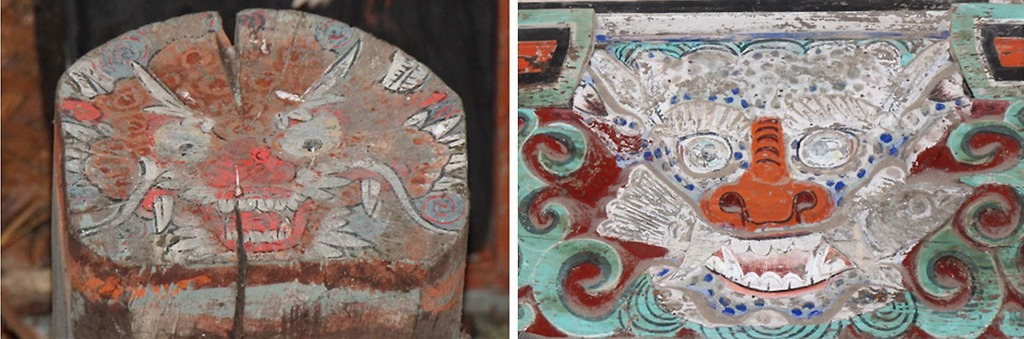
If you actually count up where byeoksa objects are placed, the same principle shows through. Ghost-face roof tiles sit at the edge of the roof, village guardian posts stand at the entrance to the village, sacred rope hangs above the door, red beans lie on the threshold — every single one sits exactly on a line where one thing splits from another. There is no byeoksa in the middle of a room, or the middle of a courtyard. Where there is no line to defend, the very act of "blocking" cannot exist.
And among all these lines, the one refined with the most precision is the changho lattice.
In the next installment, we'll look one by one at the defensive motifs humans carved onto this precarious line.
Source
- Mary Douglas, Purity and Danger (1966)
- Arnold van Gennep, The Rites of Passage (Les rites de passage, 1909)
Browse the pattern designs in Pyeongmok Studio
Go to the Collection