
Yogwe, Dokkaebi, and Chiyu, the Heavenly King
This series · Ward Off, Call Forth · No. 3 (4 episodes total) Ongoing
"Ward off what's bad, call forth what's good."
- No. 1 The Brain That Invented Ghosts
- No. 2 The Precarious Line | The Door, Where Safety and Fear Cross
- No. 3 Yogwe, Dokkaebi, and Chiyu, the Heavenly King
- No. 4 Barriers Laid on Every Side, and the Byeoksa of Today
Originally written in Korean by the author. Translated with the help of AI. Read the original
You are free to quote and excerpt posts and records from the Pyeongmok blog, as long as you credit the source (pyeongmok.com).
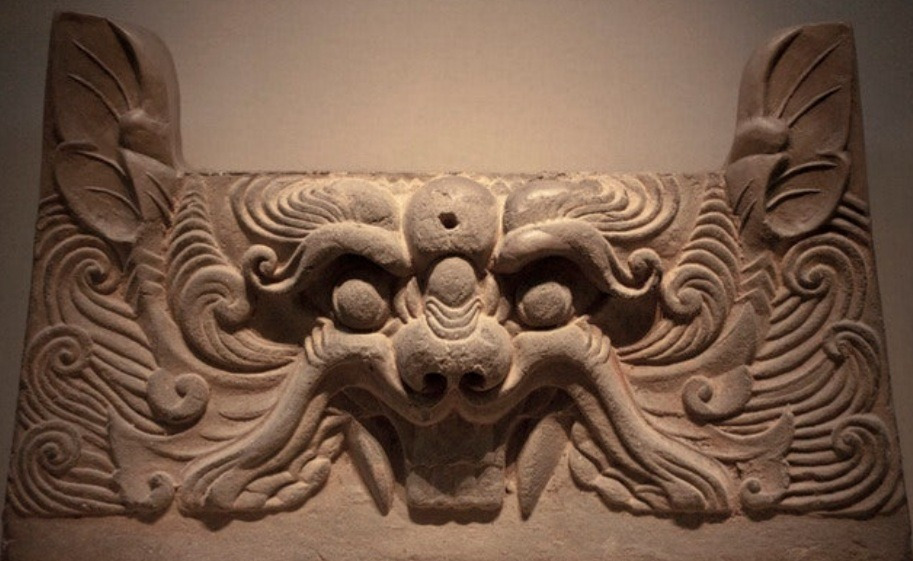
Now that the door had been set up as this narrow passage, it was time to seat the strongest possible guardian right on that precarious boundary line, to hold back the chaos outside.
Looking at the fierce faces carved into the door handles, panels, and roof-tile ends of an old hanok, we usually call them "dokkaebi."
Museums, too, have long displayed them under the label "dokkaebi roof tile."
But this name has a genealogy. The horned, iron-club-wielding "dokkaebi" we're familiar with is, in fact, the iconography of the Japanese oni (鬼).
Passing through textbooks and translations from the Japanese colonial period, the image of the oni came to occupy the name "dokkaebi," and the face that originally sat in that spot lost its name.
That century-long mix-up deserves its own separate piece; here, let's instead ask what that nameless face really is.
To ask its identity, we first have to separate the concepts. That's because the dokkaebi we know couldn't possibly serve as a guardian of the boundary.
Unlike Western spirits — elves, fairies, pixies — who stay deep in the forest or in an entirely different spiritual world, keeping their distance from humans, a dokkaebi is an old, worn household object touched by human hands — a broom, a straw shoe, a broken pestle — come alive at night. It's a friendly local spirit that pesters you to wrestle till dawn, loves buckwheat jelly, plays mischievous pranks, and then turns around and brings you wealth. It isn't a heavy, solemn presence that holds a fixed position and guards a boundary.
The same goes for yogwe (妖怪, "strange monster").
These are nothing more than monsters formed from some strange spirit of nature, or from a wronged animal or object taking shape. The real terror that pressed in from beyond the door every night wasn't these tricksters — it was magwi (魔鬼): evil itself, the force that drags people down into corruption and ruin, the aura of plague and disaster capable of wiping out an entire family, or erasing a whole village.
It was not an opponent you could face with the playful power of a spirit.
On the front line of defense where a family's very life was at stake, humans did not post something so easily handled.
So who, then, is this face carved into the boundary?
Let's lay the scholarly discussion out honestly first. In art history, this face is called gwimyeon (鬼面, "ghost face"), and the prevailing view traces the roots of its iconography back to the taotie (饕餮) motif lineage of ancient Chinese bronzes.
A frontal image of wide-open eyes and bared teeth is an old form found on roof tiles across East Asia, so if you go strictly by the iconography's pedigree, this face may well be a form that came in from outside.
But this blog reads this face as Chiyu (蚩尤).
Who, and from where, is Chiyu? In the oldest record, Sima Qian's Records of the Grand Historian, Chiyu appears as an ancient god of war who fought the Yellow Emperor (Hwangje) for control of the realm on the plains of Zhuolu, in what is now Hebei, China.
That the historian of the Central Plains recorded him as his own ancestor's greatest rival is itself a testament to how powerful a figure he was. Myth describes him this way: head of bronze, forehead of iron (銅頭鐵額), leading countless battles without a single defeat, commanding the wind and rain.
And later texts have consistently read him as belonging to the Dongyi (東夷), the peoples east of the Central Plains.
Our own records go one step further.
The Hwandan Gogi records Chiyu as Jaoji Hwanung, the 14th Cheonwang (Heavenly King) of Baedal-guk — the country founded at Sinsi on Baekdu-san — recording that under his rule it advanced west to Cheonggu and confronted the Yellow Emperor at Zhuolu.
There is a dispute over this text's authenticity, and this blog does not treat a disputed text as a factual source.
What is clear, though, is simply this: the tradition that insists on recording the war god of Zhuolu not as some other people's mythical monster, but as a Cheonwang within our own lineage, has been carried forward with real, persistent strength.
And that tradition didn't live only on paper.
This land embraced Chiyu as the war god of its own lineage. This is not some vague tradition — it is official state record.
Joseon's ceremonial regulations describe the dok (纛) banner as "resembling Chiyu's head, offered sacrifice to when the army sets out," and under King Sejong, this dokje (纛祭) rite was incorporated into the official state sacrifices, held every spring and autumn; Yi Sun-sin himself recorded in his Nanjung Ilgi that he held a dokje rite before setting out to battle. The memory of that ritual site survives today in the place name Ttukseom.
A face a dynasty enshrined as its god of martial force — that is Chiyu. And so this blog reads it as follows.
Wherever the iconography's pedigree may trace back to, what the post of boundary guardian demands is not bloodline, but qualification.
Holding back magwi is not the business of a merciful god, but of a force stronger still — and on this land, the only being the state itself enshrined with that qualification, sacrifices and all, is Chiyu.
Whatever the face's form may resemble, what people poured into that face was the power of a god of war.
It's now clear why humans nailed the face of the most ferocious god of war, not a merciful deity, onto the boundary of a door panel.
An eye for an eye, a tooth for a tooth. It was the strategy of byeoksa: meeting the most merciless chaos from outside with a force stronger still.
Those two eyes carved into the door handle glare fiercely outward. It is a form radiating, with its entire body, the warning that a god of war stands blocking this spot, and that no evil aura will remain whole the instant it crosses this line.
Only with the conviction that this overwhelming guardian was repelling the chaos right at the door could a person finally close the heavy wooden door, stretch out, and fall asleep.
Source
- Veritable Records of King Sejong, Vol. 133, "Five Rites," Military Rites, Prefatory Notes, "Dok (纛)" (the form and system of the dok banner)
- Veritable Records of King Sejong, Vol. 12, record of the Dokje rite, Year 3 of Sejong
- Nanjung Ilgi (Admiral Yi Sun-sin's War Diary), entry from the gyesa year (1593)
- Related records within the Hwandan Gogi (a fringe-historiography source concerning Chiyu and the dok banner)
Browse the pattern designs in Pyeongmok Studio
Go to the Collection