
There's No Way to Make It Match
This series · What the Eye Does, What the Mind Does · No. 2 (3 episodes total) Ongoing
"Some things stay invisible until you look at them apart."
- No. 1 The Eye Gets Fooled
- No. 2 There's No Way to Make It Match
- No. 3 Nobody Ever Stands in That Spot
Originally written in Korean by the author. Translated with the help of AI. Read the original
You are free to quote and excerpt posts and records from the Pyeongmok blog, as long as you credit the source (pyeongmok.com).
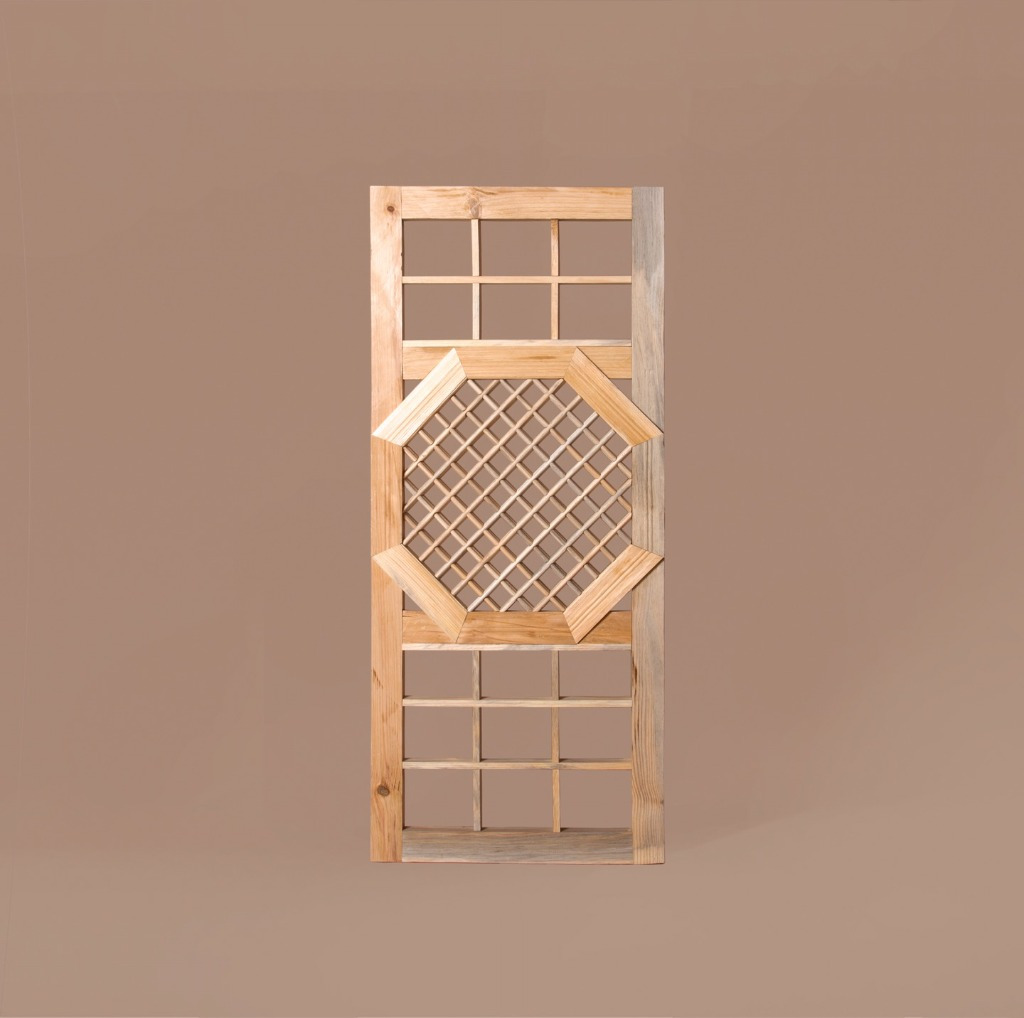
The Corners of an Octagonal Bulbalgi's Diagonal Lattice
If you've ever joined an octagonal bulbalgi, you'll know. This one simply doesn't divide evenly.
A square works out cleanly. Since all four sides meet at right angles, a diagonal lattice cuts across every side at the same interval, and even at the corner it passes exactly through the midpoint.
Fix the number of cells, and everything else falls into place.
An octagon has two kinds of sides. There are sides standing straight, and sides tilted at an angle, and the same diagonal lattice cuts across these two at different intervals.
Set it to divide evenly on the straight sides, and there's a remainder on the tilted sides; match the tilted sides, and there's a remainder on the straight ones.
It feels like there should be some number of cells out there where both divide evenly, so you sit down and try dividing it every which way — but there isn't one.
The same goes for the corners. For the diagonal lattice to split an octagon's corner exactly in half, a slat would need to stand at precisely that angle — and no such angle exists in a diagonal lattice.
There was never, from the start, a way to make all eight corners line up.
Using a better ruler won't fix this. There simply is no number that works.
So What Do You Do?
When there's no number that works, a carpenter's job changes. It stops being about finding the right answer, and becomes about deciding where to send the error that's going to be left over no matter what.
There are only two places to send it: pile it up at the corner, or spread it out little by little across the inner cells.
Pile it at the corner, and it's instantly visible. The human eye is uncannily good at catching lines that meet unevenly at a corner.
By contrast, one inner cell being very slightly wider than the others — nobody notices, unless they measure it side by side.
The same size of error becomes a flaw in one spot and nothing at all in the other.
So the width of the slats where they meet the frame is set slightly differently, cell by cell. You match the corner first, so its center lands right, and scatter the remainder inward.
Take an old door apart, and that's exactly how it's built. Measure it, and it's there.
Fooling and Hiding
The previous piece was a story about the eye being fooled. It was about making things differently in order to make them look the same.
This is a different matter. Here, the eye isn't fooled at all. You find the spot the eye doesn't inspect, and you place the error there.
The old saying that if the mind is not present, one looks but does not see — I knew that saying long ago. I only understood what it meant much later.
That the eye doesn't see everything just because it's right there in front of it — that it only sees where the mind chooses to look — I only understood after actually deciding where to send an error.
Not what you know, but knowing where to look.
That, too, is an eye for it.
And it just so happens that this exact spot matters most. The bulbalgi sits right in the middle of a bunhapmun, right at standing or seated eye level.
It's the changho the eye lingers on longest anywhere in the house — and geometrically speaking, it's the changho that fits together worst of all.
Different Eyes
The changho I see and the changho seen by someone seated on the wooden floor are not the same object. I see the spacing of the slats; they see light and shadow.
Neither eye can be called the correct one.
But the maker can't trust only their own eye. They have to guess at the eye of the person who doesn't live inside that spacing too.
Where the error gets sent is, in the end, decided by that guess.
What Lived in the Hand, but Had No Words
I didn't learn this in words.
When drawing a full-scale layout, lower the slat slightly at an octagon's corner. That was the only instruction I ever heard when I was learning.
Why to lower it, and by how much — there was none of that.
It's not that they withheld it out of unwillingness. It lived in the hand, but there were no words to carry it across.
The hand knew where the error needed to go, and that knowledge never had a name attached to it.
Source
- The Great Learning (大學), Commentary Ch. 7, "Simbujaeon sihaebulgyeon" (心不在焉 視而不見, "if the mind is not present, one looks but does not see")
- Jakob von Uexküll, A Foray into the Worlds of Animals and Humans (Streifzüge durch die Umwelten von Tieren und Menschen, 1934)
Browse the pattern designs in Pyeongmok Studio
Go to the Collection