
Nobody Ever Stands in That Spot
This series · What the Eye Does, What the Mind Does · No. 3 (3 episodes total) Ongoing
"Some things stay invisible until you look at them apart."
- No. 1 The Eye Gets Fooled
- No. 2 There's No Way to Make It Match
- No. 3 Nobody Ever Stands in That Spot
Originally written in Korean by the author. Translated with the help of AI. Read the original
You are free to quote and excerpt posts and records from the Pyeongmok blog, as long as you credit the source (pyeongmok.com).
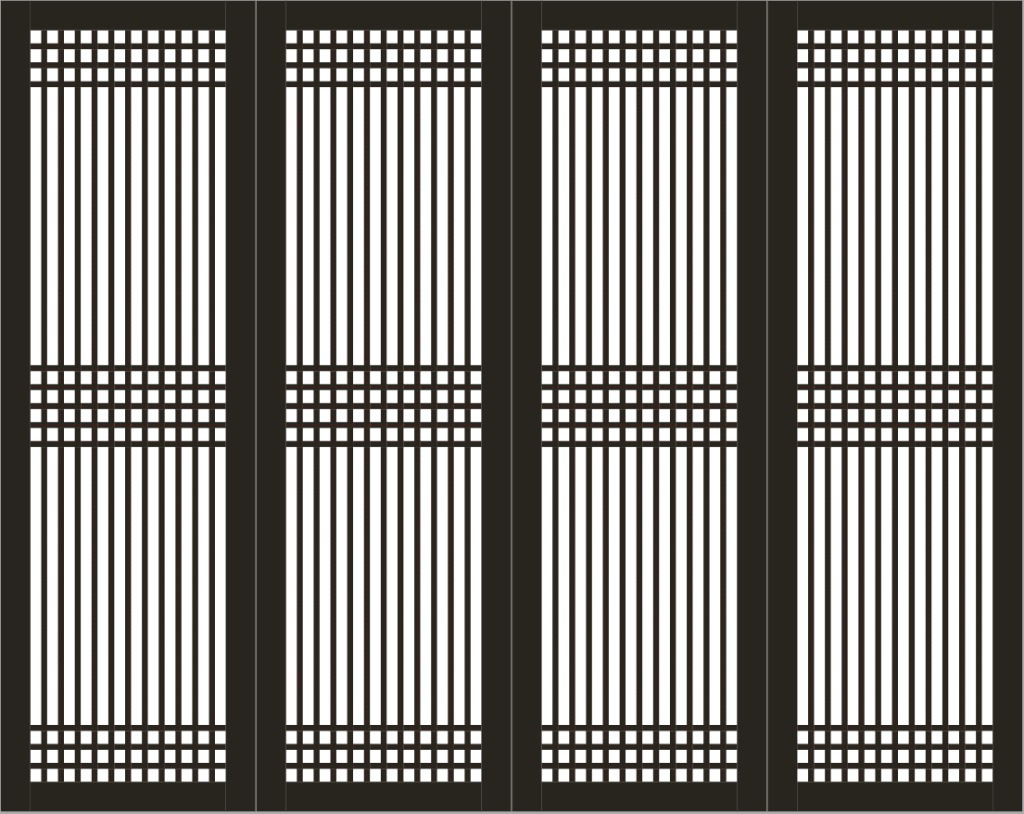
Drawings and Perspective
Drawn Head-On
A carpenter draws a door head-on. It's called an elevation, and every single slat goes in at its true, actual dimension. It's convenient — easy to measure, easy to divide, easy to hand off to someone else. But no one ever stands in the spot that drawing shows. A front elevation is a picture seen from very far away from the door, with one eye, perfectly still. Only then do all the slats line up at exactly the same size. There's no such spot inside a house. There's no such eye, either.
Perspective Is the Same Way
Perspective looks honest. Draw far things small and near things large, and it seems like a direct transcription of what the eye sees.
What perspective assumes is a single eye. One eye, fixed in one spot. A person has two eyes, sits down and stands up, walks around. There's exactly one spot where a picture drawn in perspective lines up correctly, and step just one pace away from it, and it goes wrong.
So it's a bit much to call perspective a lie. To put it precisely, it's a picture drawn by discarding things. It discards the second eye, discards movement, discards time. And the more it discards, the cleaner it looks on paper.
It Only Works from One Spot
The extreme case of this sits in Rome. The ceiling fresco of Sant'Ignazio.
Andrea Pozzo painted it so the ceiling appears to open up, with architecture soaring skyward above it. He was so skilled at keeping a painted flat surface from reading as flat. Stand on the spot marked on the floor, and it really does look that way. Step just a few paces off it, and it collapses. The columns bend, the building spills over.
Pozzo wrote it himself: perspective is the work of counterfeiting truth, so it's enough for it to look real from one designated point.
He even marked the spot on the floor. And yet people don't stand there. They walk around and look.
There's One More Thing It Discards
I said it discards the second eye, movement, and time. There's one more.
Lean a finished door against a wall and look at it. Step back a pace and look.
It seems like you're looking at it steadily, but you're not. The eye sweeps across the frame, drifts to the lattice, drops down to the panel. It never stays in one spot. That's because the range that appears sharp is very narrow. Anything you don't shift your gaze onto stays blurred.
A 2025 study (Martin et al., Scientific Reports) ran an experiment like this.
Six participants were shown a picture. In the brief instant their gaze shifted toward a corner, the picture in that corner was quietly swapped out. Almost no one noticed.
After the experiment, they were shown two images side by side and asked: which of these have you seen before?
One was the original, shown every single time. The other was an image they'd never once been shown — stitched together from the pieces the participant's gaze had actually landed on.
All six chose the stitched-together one. Five of the six said they'd never seen the original that had actually been shown every time.
What we call "a single scene" is exactly this. It's pieces the eye has swept up and stitched together. You can't see the seams.
Perspective draws neither what the eye does nor what the mind does. It's just a rule for transcribing lines radiating from a single point onto a flat surface. It isn't how a person sees. It's something mathematics drew.
If you don't know what a picture discards, it's correct on paper and wrong in place. That's exactly why the person who's building the thing needs to know this.
A Door Isn't a Picture
A picture is the same picture no matter where you view it from. A door is a different door no matter where you view it from.
Stand at an angle, and you see the side face of the slats. The length of the shadow changes. Walk past, and the pattern shifts along with you. A door is redrawn every single time.
So things that aren't in the drawing are doing work in the actual door.
One Thing That Gets Discarded Is Thickness
Viewed head-on, a slat's thickness doesn't show. It's not in the drawing either. A slat's width shows up in the drawing as-is, but there's no place for its thickness to appear at all. And yet the viewer's eye does see thickness. At the same width, a thinly joined slat looks slender and weak, while a thickly joined one looks solid. It isn't only about appearance, either. Light never comes in head-on. For the sun to face a changho straight on, it would have to be sitting right on the horizon — and there's no such light in Korea. It always slants in from above.
Because it comes in at a slant, the slat's thickness comes into play. That thickness decides how much light gets in, and decides how long the shadow falls. Thin, and more light gets in, and the shadow falls short. Thick, and the opposite happens. A slat's thickness decides the amount of shadow, and the amount of shadow decides the door's sense of volume. Two doors joined with the exact same lattice division become different doors depending on their thickness. And how much is the right amount isn't fixed either. It changes with the size of the door, and changes again if the slat width changes. It's the same story I told in the previous piece about cell proportions. None of that judgment survives in a front-on drawing.
There's One More Pattern on the Paper
I once joined a partition. Three panels, jeongja-sal, papered with hanji. I set the slats at 25 millimeters. A partition isn't hung from a door frame — it has to stand on its own, so the slats run thicker.
Standing it up in the yard, I saw the paper carried a double grid. One layer of slats, one layer of the slats' shadow. And the shadow wasn't sitting on top of the slats — it sat off to the side.
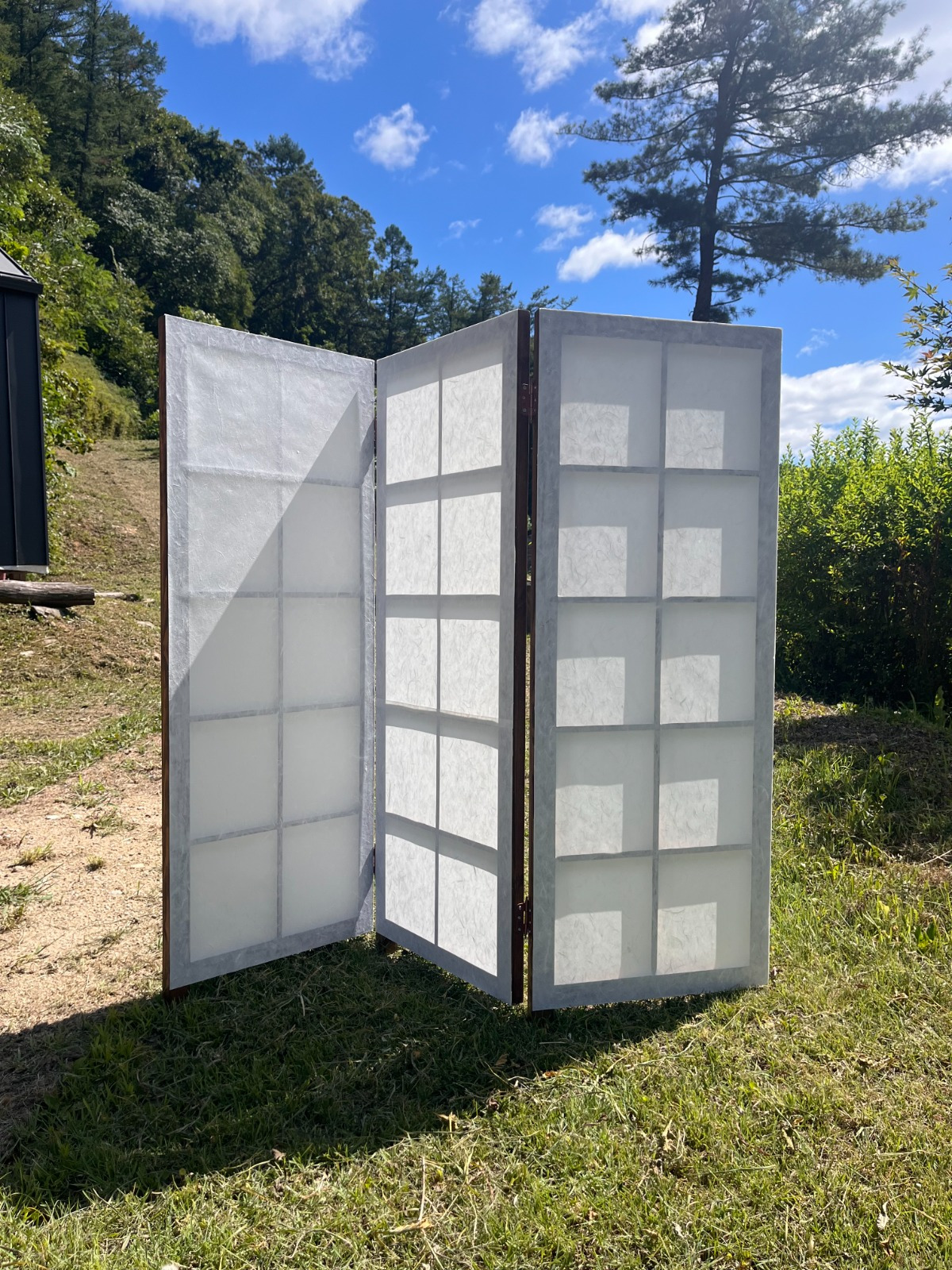
The paper is applied to one face of the slats. Which means there's a gap between the slat and the paper equal to the slat's thickness. Since the sun comes in at a slant, the shadow is pushed over by that same gap before it lands on the paper. The thicker the slat, the farther it's pushed. Thin, and it overlaps right behind the slat and stays hidden.
The three panels stand at three different angles. So a single object carries three patterns at once. The lattice division is identical on all three.
The same thing happens in a changho. It's just harder to see. Light coming into a room is usually diffuse, so the shadow is faint, and a changho faces only one direction, so it carries only a single pattern. But in the low morning or evening sun, this double layer shows up on a changho too, exactly the same way.
In a drawing, a slat is a single layer. No thickness, so no shadow. But in reality, one more pattern is born, and that pattern moves position all day long, following the sun. Come evening, it disappears.
Where Is a Changho Seen From?
A door isn't something hung up to be viewed head-on.
Sit on the floor, and eye level drops. Step into the room, and you view it at an angle. Walk past it, and the spacing of the slats streams by. Light from behind turns the slats into black lines; light from in front creates a separate shadow. The same door looks completely different every time.
A carpenter draws from a spot nobody ever stands in, and sends the result out into all the spots real people actually stand.
What's left is crossing that gap. It's not something a ruler can do.
Knowing that where you draw from and where it's seen from are different, and drawing with that in mind anyway — that, too, is part of the work of drawing.
When setting a slat's thickness, what you're measuring isn't just its bulk. That thickness also decides the very shadow that will fall on the paper.
You're setting a dimension based on a shadow that doesn't even exist yet. A ruler has no marking for that.
That, too, is an eye for it.
Source
- M. H. Pirenne, Optics, Painting and Photography, Cambridge University Press, 1970.
- D. Vishwanath, A. R. Girshick, M. S. Banks, "Why pictures look right when viewed from the wrong place," Nature Neuroscience 8 (2005), 1401–1410.
- D. Martin, D. Gutierrez, B. Masia, S. DiVerdi, A. Hertzmann, "Viewers perceive shape in pictures according to per-fixation perspective," Scientific Reports 15 (2025), 15414.
Browse the pattern designs in Pyeongmok Studio
Go to the Collection