The Misunderstanding About Kumiko (組子)
This series · Korean and Japanese Changho · No. 3 (6 episodes total) Completed
"They look alike, but there's a reason for the difference."
- No. 1 Why We Need to Talk About "Wabi-Sabi" Before We Open Japan's Door
- No. 2 The Structural Reversal Behind Korean and Japanese Changho, and Climate
- No. 3 The Misunderstanding About Kumiko (組子)
- No. 4 The Lattice's Relaxed Proportion vs. the Strict Division of Line and Plane
- No. 5 Two Ways of Handling Space: Korea and Japan
- No. 6 Korean Changho and Japanese Shoji | Why Are They Different?
Originally written in Korean by the author. Translated with the help of AI. Read the original
You are free to quote and excerpt posts and records from the Pyeongmok blog, as long as you credit the source (pyeongmok.com).
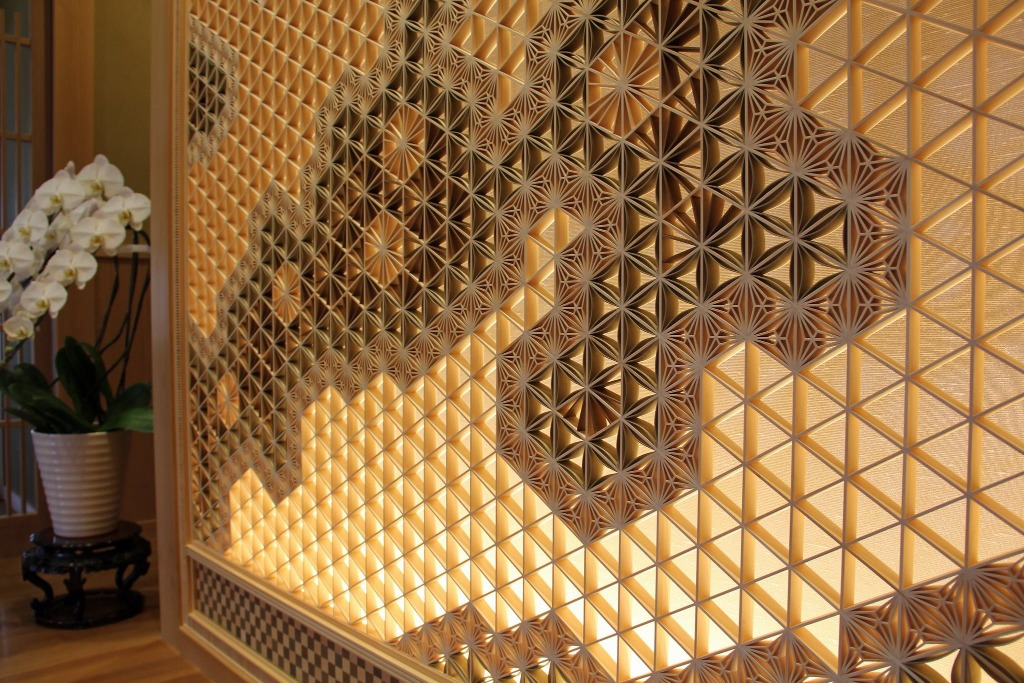
In the previous chapter we confirmed that the crisp neatness of Japan's shoji is an effect of where the paper is applied, and of the shadows created by the climate. But there's another common trap the public falls into when talking about Japanese lattice: placing "kumiko" (組子) side by side with Korean lattice patterns and concluding that "Japanese lattice is far more sophisticated."
The short answer: this comparison gets the subject wrong from the start. What should be compared with Korean changho isn't kumiko — it's shoji (障子).
The public often uses "kumiko" interchangeably with the name of the Japanese lattice pattern itself, but kumiko isn't a name for a type of changho or door. It's the name of a woodworking technique — joining pieces of wood into geometric patterns by cutting grooves, without nails. It's sometimes used in shoji, but it's a specialized technical field spanning woodwork broadly, including furniture and decorative objects, and the lattice-paper changho actually used in ordinary Japanese homes is the shoji. To compare everyday changho-and-door culture, you have to compare changho against changho — not a technique. Setting kumiko, a specialized craft, side by side with everyday Korean lattice is a mismatched comparison from the start.
Once you match the weight classes properly, it becomes clear that the two countries' changho were solving different problems.
Korean changho were members of the outer wall, meeting wind and rain directly. So the lattice joinery itself carries both mechanics and narrative together.
- Eogeum-yukmo-sal: a joinery where the lattice lines shift out of alignment to form hexagons. Going beyond a simple horizontal-vertical crossing to include a diagonal direction as well, it disperses force pressing in from three directions, creating a structure resistant to warping using nothing but the wood's grooves and joinery.
- Gyo-sal: a technique that weaves a diamond-shaped net by densely crossing slats at 45°. The diagonal structure isn't just visually striking — it also has an engineering stability that scatters the deformation pressure placed on the door panel in every direction.
- Wanja-sal: a character written in lattice, where the bends of a continuous line carve in a wish for prosperity and long life.
- Geobuk-sal (tortoise lattice, also called gwigap-sal): a byeoksa joinery meant to hold back bad energy from beyond the door, using the geometry of a tortoise shell as a symbol of longevity and protection.
Korean craftsmen embraced a "margin for warping," letting the wood breathe and settle through the four seasons, while embedding structural engineering like eogeum-yukmo or gyo-sal on the inside. It's a design of outward gentleness, inward strength.
Japan's shoji starts from different conditions. Japan's climate is hot and humid, an environment where wood contracts and expands severely. A precise, thin-slatted grid warps easily against changes in humidity, so the shoji settled into a role as an interior fitting that could only hold up on the inside, once the eaves and the amado (rain shutters) had already filtered out the wind, rain, and moisture once.
Freed from the burden of structural resistance, the shoji was standardized into a fitting sized to the tatami module, and the orderly grid, along with the shadow cast by diffused light passing through washi paper, later became a core element of Japanese architectural aesthetics. It's in this context that Tanizaki Jun'ichiro, in In Praise of Shadows, found Japanese beauty not in light but in shade. Its variations, too, developed in the direction of handling light and space — using the grid's proportion to control light, as in yokoshige, or drawing the garden into the room at seated eye level, as in yukimi shoji.
To sum up: dragging in kumiko, a specialized craft technique, to claim the superiority of Japanese lattice is a misunderstanding that confuses a specialized craft with everyday changho. And what a properly weight-matched comparison reveals isn't superiority or inferiority — it's a difference in direction. The shoji, in a spot isolated from humidity, dug into the problem of staging light and space, and arrived at an aesthetic of standard dimensions; Korean changho, standing in a spot that confronted nature directly, layered structural engineering and a narrative of byeoksa and gilsang into a single piece of lattice joinery.
The sophistication of Korean changho isn't in surface flash — it's on the inside of the joinery. The moment the standard of comparison changes, that sophistication simply becomes invisible.
Source: Tanizaki Jun'ichiro, In Praise of Shadows
Try designing this lattice yourself
Try adjusting the 육모솟을살(Hexagon Lattice) pattern covered in this post yourself, right in the studio.
Open in studioBrowse the pattern designs in Pyeongmok Studio
Go to the Collection