
Buddha's Palm
This series · Back at the Bench · No. 2 (6 episodes total) Ongoing
"Writing down the thoughts that come while I build."
Originally written in Korean by the author. Translated with the help of AI. Read the original
You are free to quote and excerpt posts and records from the Pyeongmok blog, as long as you credit the source (pyeongmok.com).
Doing carpentry work, you start wanting to change something up, thinking "this might just work," and you turn it over in your head a lot.
But it's Buddha's palm.
(In Journey to the West, the Monkey King somersaults to what he thinks is the edge of the world — only to find he never left the Buddha's palm.)
You feel it in your bones — there's nothing new under the sun.
Every joinery and fitting that's possible already exists within thousands of years of accumulated wisdom.
Here's something I felt today.
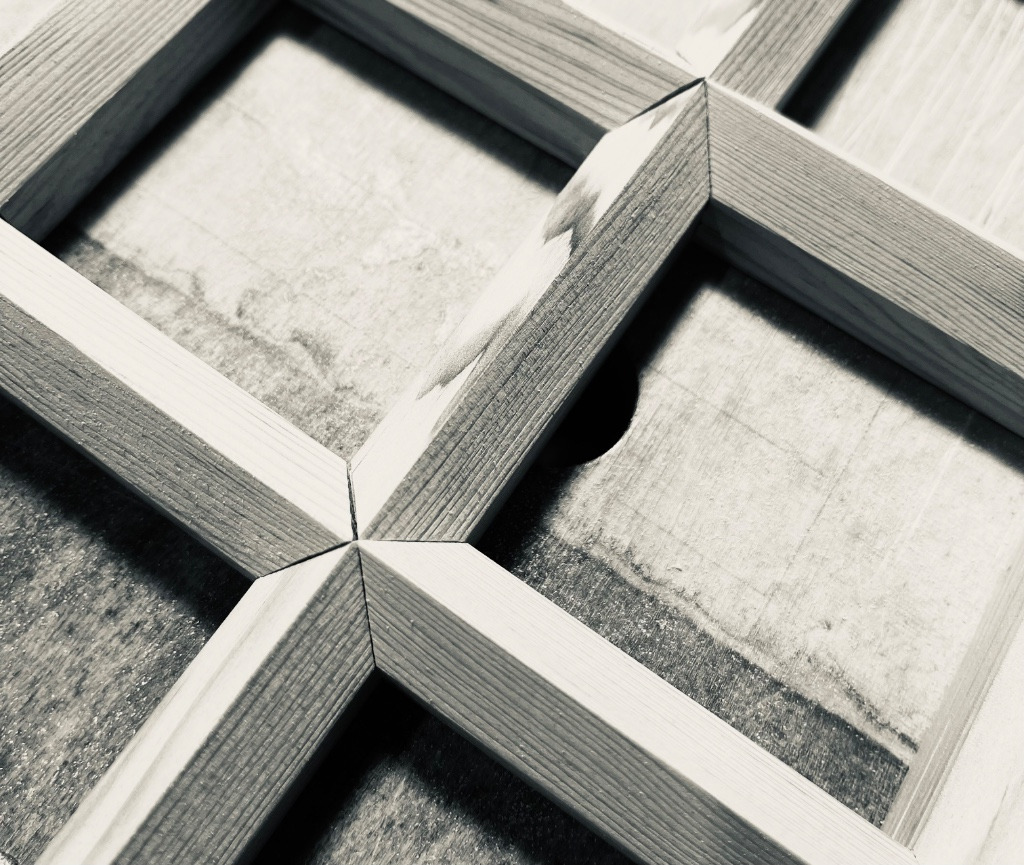
I was working out a joint where the corners of a square all converge on a single point, while still keeping the wood's natural texture visible.
In my head, it was solved.
But the moment the square chisel's angle was off by even a hair, a gap opened up.
A joint where the corners converge on a single point has nowhere to hide an error.
And since I'd committed to keeping the texture visible, I couldn't just sand the surface down to smooth it over, either.
Wrestling with it like that, I realized something. This joint — it was already used in traditional furniture.
I'd thought I'd worked it out myself. Well.
Still, it's not that I copied it. It's that I worked on the same problem and arrived at the same answer.
Every time my chisel slipped a little, I was learning, in my own body, why the old somokjang (fine-furniture joiners) built it that way.
Only one thing is different. They used this joint in chests and cabinets,
and I'm hanging it on a door.
Furniture only has to hold its own weight inside a room,
but a door faces wind and rain, takes impact every time it opens and closes, and expands and contracts with every season.
Whether this joint holds up in that spot is something I still don't know.
Tradition might not be about memorizing the right answer — it might be about solving the same problem all over again.
Now it's my door's turn to give that answer.
joinery, square chisel,
Go to the Collection