
The Palm Is an Eye, Too
This series · Back at the Bench · No. 7 (8 episodes total) Ongoing
"Writing down the thoughts that come while I build."
- No. 1 The Work of Pyeongmok
- No. 2 Buddha's Palm
- No. 3 Still Building, Today Too
- No. 4 Keep Changing the Form, and the Difference Gets Buried in Noise
- No. 5 Before the Saw's Path Sets
- No. 6 Afraid I'm Thinking to Fit My Own Skill
- No. 7 The Palm Is an Eye, Too
- No. 8 A Sense Doesn't Cross Over by Explanation
Originally written in Korean and translated into English with the help of AI. Read the original
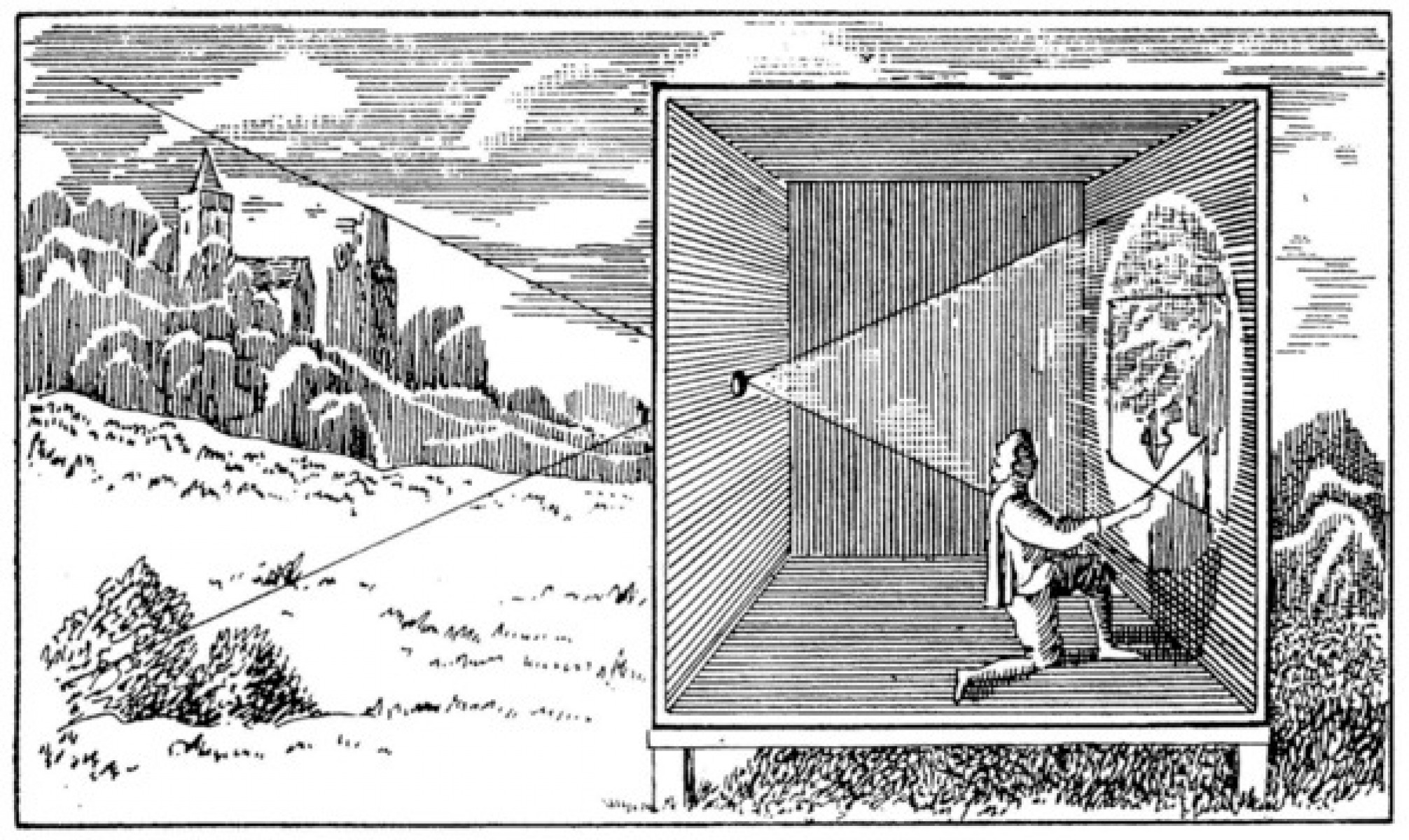
Yesterday I read an article about AI in the newspaper. It said AI had solved a hard math problem, and that it can even find the subscriptions you're not using and cancel them for you. About halfway through, the article brought up the camera and Impressionism — the anecdote that when the camera first appeared, a painter named Delaroche declared, "From today, painting is dead." Apparently it's not certain he ever actually said it.
It's a story I often bring up myself when I talk about AI, so I was glad to read it. The article wraps it up by saying painting survived after all, but at that point my thoughts drifted somewhere a little different. I put the paper down and followed that thought for a good while.
The camera was originally a tool for drawing. Make a small hole in a pitch-dark room, and the scene outside is cast upside down on the opposite wall — and for a long time painters looked at it and traced it. When the light went, the projected image went with it, so it had to be carried over by hand. Then, in 1839, came a way to fix that image in place with chemicals. The picture could now stay without a hand.
The ones who got scared back then were probably mostly painters who made their living by drawing things exactly as they were. People who painted portraits, people who painted smoothly, without a brushstroke showing, and hung their work in the Salon. The Impressionists, too, first learned to paint by looking at that Salon. But once copying things exactly could be handed over to photography, they held on to what to look at, and why to look at it that way. So they went outdoors to paint the moment when light lingers. So rather than saying painting survived, I think it's more accurate to say the work painting did changed.
Watching AI these days reminds me of that time. For a long time the computer was a tool that helped with my work, and what to draw was always up to me. But now you write a single line, and the result just comes out. Still, if you hand it over without any particular direction, you usually get something inoffensive. Because it picks the most plausible option out of countless pieces of material, it leans toward an average — something you feel you've seen somewhere before.
The human eye is a bit different. Light has no color of its own; it only has wavelengths. Those have to pass through the eye and into the mind before they become red or blue. That's why everyone sees a little differently, and even within one person, color keeps shifting. Someone who has handled paint for a long time sees many different things in what looks like plain gray to others, and when you come to want something, that color keeps catching your eye. And they say that as you age and the lens of your eye yellows, less blue light gets in — yet the mind fills in the gap and still shows you blue as blue.
The red that AI knows is a consensus of the things people have called red. It's a color value made of numbers, an average gathered from what countless people have named. AI paints with that, but it has no eyes to actually see red.
When a person paints, it's different. In the moment you're mixing paint and stop and say, "That's it," it's that person's eye doing the judging. The eye that sees a little differently from others, and a little differently from yesterday, decides the color. That's why a color a person has applied carries the way that person saw. The viewer, too, sees it again with their own eyes. In front of a single picture, two different eyes meet.
But that eye is something cultivated — by how you grow up, what you learn, what you long for — so what you cultivate it by looking at starts to matter. If you spend all day looking only at the colors and houses and patterns a screen picks out for you, I wonder whether your eye won't come to resemble that inoffensive side too. That worries me more than a machine producing averages. So these days, when I find myself liking something, I try to tell whether it came from my own life or from a screen.
Working wood in the workshop, I think about this often. Even boards ripped from the same log differ in grain and in where the knots sit, and even after a piece is finished and installed, its color deepens year by year and its scent rises again every summer. After planing, I always run my palm over the surface once — even when it looks smooth to the eye, the hand knows first where it catches. To me, the hand is part of the eye too. AI may know the word "grain," but it has no palm to run over it.
I became a carpenter after working in design, but that doesn't mean I keep machines at arm's length. Our workshop cuts changho on a CNC, and I also built a design tool called Pyeongmok Studio, where anyone can draw a pattern that fits their own room. But even that tool can't decide for you which pattern is good. Choose the average, and all you get is the average.
When I choose a board in the workshop, I flip it over several times. Which face goes toward the room isn't in the drawing or in the design tool — it's decided by my eye, which is growing old looking at all sorts of things.
These days, when you choose something, I hope you'll ask yourself, at least once, whose eye that is.
I stopped partway through the newspaper, and my thoughts ended up here.
You are free to quote and excerpt posts and records from the Workgroup Pyeongmok blog, as long as you credit the source (pyeongmok.com).
If you spot an error or have any thoughts on this post, please email us at .
Browse the pattern designs at Workgroup Pyeongmok
Go to the Collection