Before the Saw's Path Sets
This series · Back at the Bench · No. 5 (6 episodes total) Ongoing
"Writing down the thoughts that come while I build."
Originally written in Korean by the author. Translated with the help of AI. Read the original
You are free to quote and excerpt posts and records from the Pyeongmok blog, as long as you credit the source (pyeongmok.com).
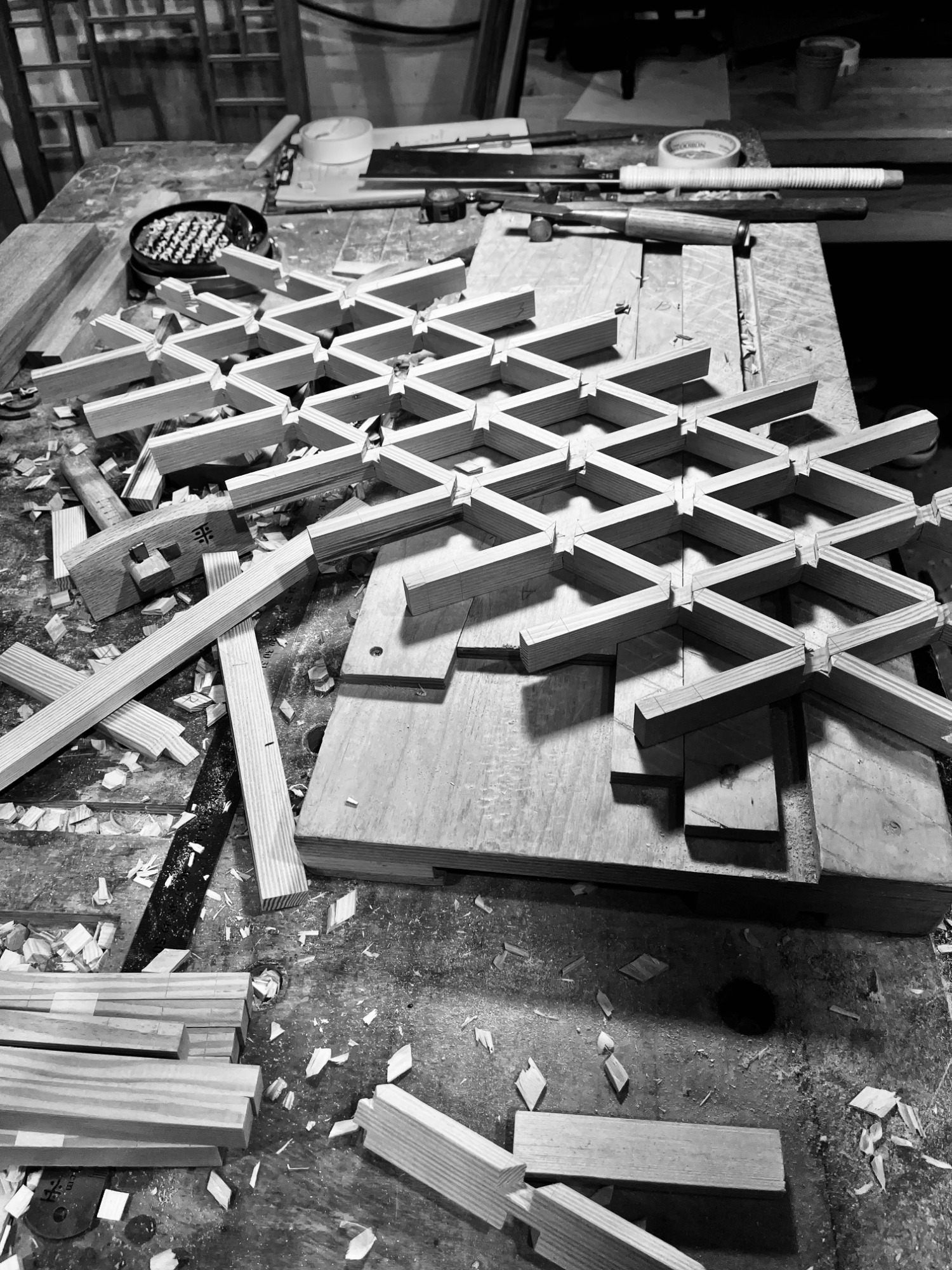
I cut half-lap notches for semo-sotgeul-sal today.
Since the slats run in three directions, the notch is different for every direction.
Even a small slip in the sawing makes the slat twist during assembly. It gets stiff, binds up.
The straighter the saw's path comes out, the less chiseling is left to do afterward.
I did nothing else all morning.
Repeat the same task, and the hand tires first. Tired, and force creeps in.
My teacher once told me a saw cuts with its own weight. At the time, I just took his word for it.
It felt like nothing would cut without force behind it, and I didn't understand why he'd say that.
Today, the saw drifted off course at every spot where I'd applied force. The blade is thin. Downward pressure doesn't stay purely downward.
Even the slightest misalignment in the gripping hand turns that force into a twisting force.
Let go of the force, and all that's left is the saw's own weight — and its own weight lands evenly across the blade's face. There's no reason left for it to twist.
And yet there were spots that drifted even with the force let go. A half-lap notch is shallow.
It's only half the slat's thickness — it goes in about 10mm and stops. A saw carves out its own path over its first few strokes.
Once that path forms, the path itself holds the saw steady from then on. A half-lap notch finishes cutting before that path has a chance to form.
Which means whatever angle you set at the very start simply stays as it is. And that's exactly the moment I'm looking at the blade.
I look because I have to match it to the ink line. I look again to check it's seated right.
To look, my eye has to move up over the saw's path. To do that, my head tilts.
Tilt the head, and the shoulder follows along. I cut standing up, and in this posture, the saw doesn't go wherever my arm sends it.
It travels along the plane my shoulder has set.
My posture had twisted by exactly as much as I'd been looking.
Browse the pattern designs in Pyeongmok Studio
Go to the Collection