
Keep Changing the Form, and the Difference Gets Buried in Noise
This series · Back at the Bench · No. 4 (6 episodes total) Ongoing
"Writing down the thoughts that come while I build."
- No. 1 The Work of Pyeongmok
- No. 2 Buddha's Palm
- No. 3 Still Building, Today Too
- No. 4 Keep Changing the Form, and the Difference Gets Buried in Noise
- No. 5 Before the Saw's Path Sets
- No. 6 Afraid I'm Thinking to Fit My Own Skill
Originally written in Korean by the author. Translated with the help of AI. Read the original
You are free to quote and excerpt posts and records from the Pyeongmok blog, as long as you credit the source (pyeongmok.com).
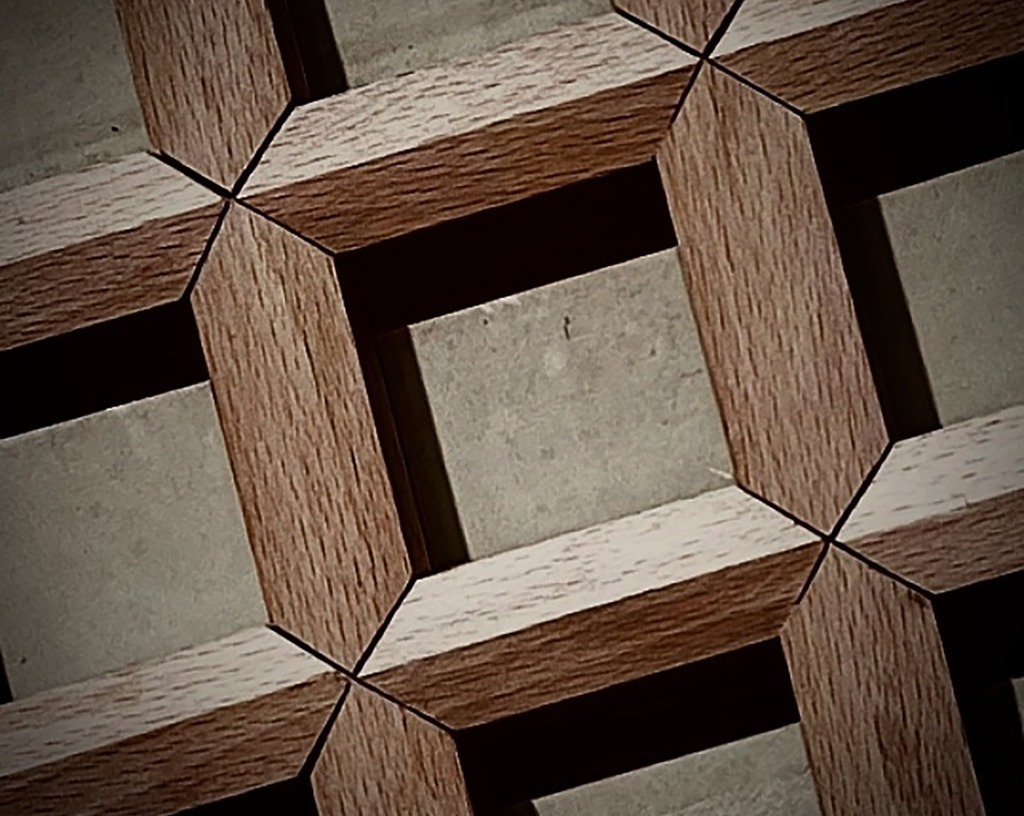
Changho have been joined the same way for hundreds of years. The way the slats are joined is the same, the proportions are the same, the joinery is the same.
Not changing is the rule.
And yet no two changho are ever alike.
The wood is different, the hand is different, the day is different.
It's precisely because the form is fixed that this difference becomes visible.
Keep changing the form, and the difference gets buried in noise. No single slat is an invention.
It's the same member it's been for hundreds of years.
And yet the pattern is born in how slat meets slat — in the spacing, the proportion, the crossing.
The same slat can become jeongja-sal, or it can become yongja-sal.
Creation doesn't live in the material — it lives in the joinery.
Doing carpentry work, your head fills up with wanting to do it differently, newly, more impressively.
In fact, that gets in the way of the work. The urge to make something new shakes your hand.
Then, in Bresson's notes, I came across this line.
"Change nothing, so that everything is different."
Robert Bresson was a French film director.
Over nearly 50 years of work, he left behind 13 feature films.
It's not that he made few films — he made them only at the pace his own way of understanding allowed.
He never used professional actors, used the word "model" instead of "actor," and had them repeat the same motion dozens of times.
Until the will to perform wore away to nothing.
Those notes became his book Notes on the Cinematographer (1975).
It's not a theoretical text but the record of someone who actually practiced, and that's where its sentences get their strength.
And a little further on, there's this line.
"To create is not to deform or invent people and things.
It is to tie new relationships between people and things which exist as they are, exactly as they are."
These two lines are a pair. If the first is a command, the second is the reasoning behind it.
Because creation isn't about touching the material — it's about re-tying the relationships between materials.
A poet doesn't invent words. The words all already exist; it's the arrangement that makes the poem.
Bresson said this about his models, but a carpenter ends up reading it back at their own head.
What needs to be discarded isn't the old way — it's my own will to make something new.
Discard that, and newness stops being something you make, and becomes something that's revealed instead.
Just as the slat stays exactly the same, and the pattern is born from the joinery.
So a carpenter starts every morning by discarding that very will.
Not once, but every single day. The thing most different of all comes out of that discarded spot.
Nothing was changed, and yet everything is different.
On the workbench, Bresson's line isn't a theory — it's something witnessed firsthand.
Browse the pattern designs in Pyeongmok Studio
Go to the Collection