Sotgeul-chang or Soseul-chang | The Correct Spelling and Its Origin
This series · A Second Look · No. 1 (8 episodes total) Ongoing
"The more firmly something has set, the more it deserves a second look."
- No. 1 Sotgeul-chang or Soseul-chang | The Correct Spelling and Its Origin
- No. 2 The Dokkaebi Has No Horns
- No. 3 Traditional Changho | Why Is This Term So Blurry?
- No. 4 Traditional Changho | Must It Be Built Exactly as the Ancestors Built It?
- No. 5 Traditional Changho | My Hand Plane Is a Japanese Plane
- No. 6 Manja-sal and Man-sal Are Different Changho
- No. 7 Mili Isn't a Water Channel
- No. 8 Jang Gi-in's Changho | Where It Comes Apart
Originally written in Korean by the author. Translated with the help of AI. Read the original
You are free to quote and excerpt posts and records from the Pyeongmok blog, as long as you credit the source (pyeongmok.com).
1. The Correct Spelling and Pronunciation: Written "sotgeul-chang," Read [soseul-chang]
Traditional changho are sometimes spelled "soseul-chang," but the correct form is to write "sotgeul-chang" (솟을창) and read it as [soseul-chang].
This follows Korean's liaison (yeoneum) rule.
- The liaison rule: when a syllable ending in a consonant is followed by a syllable beginning with the silent consonant ㅇ (i.e., a vowel), the final consonant shifts to become the initial sound of the next syllable.
- Examples with the same ㅅ batchim: 옷이 → [오시], 웃음 → [우슴], 낫을 → [나슬]
By this same rule, "sotgeul-chang" (솟을창) has its ㅅ batchim shift onto the next syllable, so it's pronounced [soseul-chang].
2. Why You Can't Just Spell It as It Sounds: A Distortion of Meaning
If you spell it phonetically as "soseul-chang," the meaning is completely distorted. That's because Korean already has the Sino-Korean word "soseulhada" (蕭瑟), meaning "the autumn wind is desolate and bleak."
The moment you write "soseul-chang," it can be mistaken for that entirely different Hanja word — "a bleak, desolate changho."
Since this changho's name actually comes from "sosaoreuda" (to rise up / surge upward), you have to spell out the true shape of the morpheme as "sotgeul-chang" (솟을창) for the original meaning to come through.
3. The Origin of "Sotgeul" and the Aesthetics of Relief
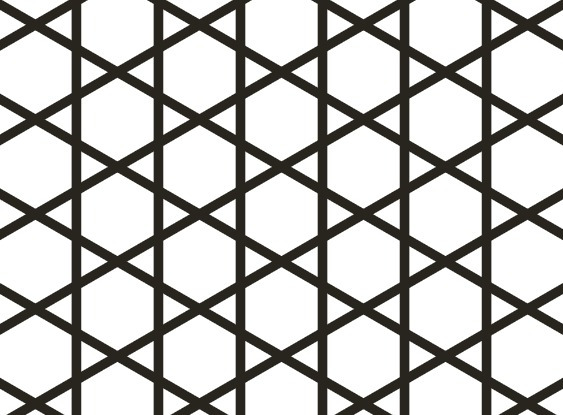
Because of the sheer precision of the representative sotgeul pattern — yukmo-sotgeul-sal (a lattice woven at angles of 30° and 60°, also called eogeum-yukmo) — many people try to trace the origin of "sotgeul" back to some mathematical angle or piece of geometry.
But "sotgeul" (솟을) is a purely native Korean word — the verb "sotda" (솟다, "to rise/surge") combined with the adnominal ending "-eul" — and it has nothing to do with numbers. It means something like "seeming to rise upward," a raised, three-dimensional vividness. Every structure in traditional architecture that carries the word "sotgeul" shares this same quality.
- Sotgeul-sal [soseul-sal]: lattice that doesn't stay flat within the wooden frame, but is carved so the slats rise up in relief, giving it three-dimensional depth.
- Sotgeul-daemun [soseul-daemun]: a gate built with its roof raised well above the flanking service wings, tall enough to pass through while still seated in a palanquin.
- Sotdae [sot-ttae]: a word formed from "sotda" (to rise) and "dae" (pole) — a pole raised high toward the sky. Depending on the region it was also called "dotdae." People of old placed a wooden bird on top of it, as a go-between carrying human wishes up to the heavens.
Addendum (July 29, 2026)
I requested a correction to the spelling in the "changho" entry (E0055558) of the Encyclopedia of Korean Culture, and received a reply from the editorial office saying they would correct it.
Soseul → Sotgeul, miri → mili (밀이). They said the change would take some time to go live, so if you open the entry right now you may still see the old spelling.
Source
- National Institute of Korean Language, Standard Korean Dictionary — "soseulhada (蕭瑟)," "sotgeul-daemun," "sotdae"
- Standard Language Regulation, Part 2 "Standard Pronunciation," Article 13 (liaison/linking sounds)
Try designing this lattice yourself
Try adjusting the 육모솟을살(Hexagon Lattice) pattern covered in this post yourself, right in the studio.
Open in studioBrowse the pattern designs in Pyeongmok Studio
Go to the Collection