Traditional Changho | Must It Be Built Exactly as the Ancestors Built It?
This series · A Second Look · No. 4 (8 episodes total) Ongoing
"The more firmly something has set, the more it deserves a second look."
- No. 1 Sotgeul-chang or Soseul-chang | The Correct Spelling and Its Origin
- No. 2 The Dokkaebi Has No Horns
- No. 3 Traditional Changho | Why Is This Term So Blurry?
- No. 4 Traditional Changho | Must It Be Built Exactly as the Ancestors Built It?
- No. 5 Traditional Changho | My Hand Plane Is a Japanese Plane
- No. 6 Manja-sal and Man-sal Are Different Changho
- No. 7 Mili Isn't a Water Channel
- No. 8 Jang Gi-in's Changho | Where It Comes Apart
Originally written in Korean by the author. Translated with the help of AI. Read the original
You are free to quote and excerpt posts and records from the Pyeongmok blog, as long as you credit the source (pyeongmok.com).
Ask what a "traditional changho" is, and most people eventually land on the same answer.
A changho built exactly the old way, exactly in the old shape. The principle of preserving original form when repairing a cultural property backs this answer up, and so does the changho sitting behind glass in a museum.
Built exactly the same is tradition; built differently is not tradition.
Let's put that answer on the workbench and scrutinize it.
The first question to ask: is building it exactly the same even possible?
Changho have been joined the same way for hundreds of years. The way the slats are joined is the same, the proportions are the same, the joinery is the same.
And yet no two changho are ever alike. The wood is different, the hand is different, the day is different.
This isn't a confession of my own laziness — it's a condition of the work itself. Even trees from the same mountain all have different grain, and even the same carpenter's hand is different today than it was yesterday.
"Exactly as an ancestral carpenter built it" is something even that ancestral carpenter himself could never build twice.
Even if he'd taken the same order the very next day, what came out would not have been identical to yesterday's changho.
So if tradition means exact replication, there's only one conclusion. A "traditional changho," in this exact sense, has never once existed in this world.
Every carpenter after the very first one to build a changho becomes, by this definition, a failure.
That must mean the definition is wrong — not the carpenters.
Let's ask from the opposite direction too. Then does it stop being tradition the moment the design differs even slightly?
Line up old changho and the answer becomes obvious. The lattice pattern was different from era to era.
It differed by region, differed between temples, palaces, and ordinary homes, and differed from carpenter to carpenter. No generation simply copied the changho of the one before it.
Each generation built the changho of its own era. Apply the standard that a different design means it isn't tradition, and every single person who ever built up this tradition is disqualified from it.
By this standard, there's no tradition left to protect at all.
And yet this standard is powerful. Let's give a name to the attitude that revokes a changho's claim to tradition just because its joinery follows the old method exactly but its pattern differs slightly: traditionalism. It sounds like a call to protect tradition, but it does the opposite. The moment you freeze the pattern, the changho stops being a thing that gets made, and becomes a taxidermied specimen instead.
Only dead things can be taxidermied. A living thing can't be frozen.
So traditionalism isn't the work of protecting tradition — it's the work of stuffing and mounting it.
Squeeze from both sides, and there's only one place left to go. Tradition cannot live in a fixed form.
Because it can never be perfectly identical, and there's no reason it should be.
So where does it live, then? In whatever crossed over unchanged, even as the wood changed, the hand changed, and the pattern changed — the joinery.
The method of interlocking slat against slat out of alignment; the proportion that divides incoming force between them; the joinery that holds without a single nail. The pattern differed generation to generation, but the method of joining carried through.
Tradition doesn't live in a changho's face — it lives in its bones. But we need to go one step further here. Because bones don't carry themselves forward on their own.
Joinery has crossed hundreds of years because, generation after generation, someone rejoined it — and rejoining it requires a reason to do so, right now, today.
I see two such reasons.
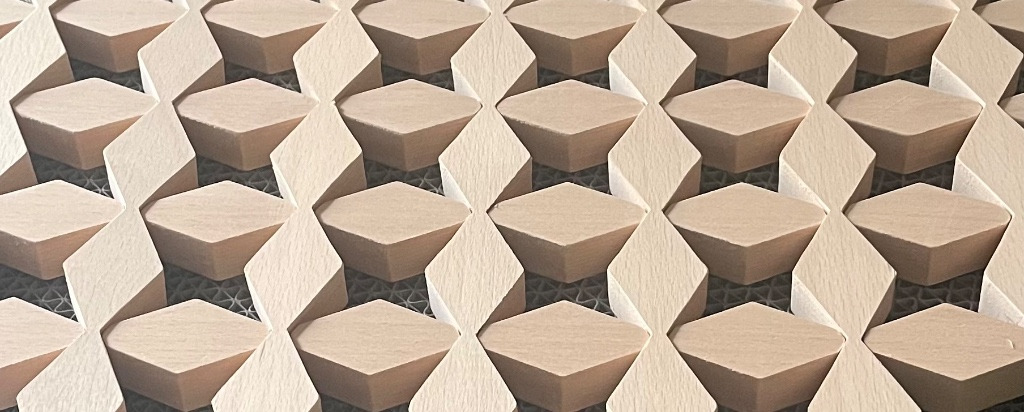
One is validity. There is a joinery called eogeum-yukmo (yukmo-sotgeul-sal).
It's a joinery where slats from three directions interlock out of alignment to form a hexagon, dividing the force coming from three directions between them, so that even thin slats resist warping.
Fit this joinery together, and you'll know it. This angle is still correct today. For exactly the same reason it was correct a hundred years ago.
Rejoining it because it's correct — that is the first reason.
The other is pride.
Not the pride of the single person who made it, but the pride of a community.
The carving on a kkot-sal (flower-lattice) door adds nothing to its performance. Carving a flower at every single crossing point of the slats takes several times the labor, for no functional gain. And yet people still stop in their tracks in front of that door today. The name of the carpenter who made it has not survived, but that door has become the object people reach for when they say, "look, this is something we have." It belongs not to the one person who made it, but to everyone who stands in front of it. Its usefulness can't explain it, yet a community is proud to call it its own. Carrying it forward because it's a source of pride — that is the second reason.
If even one of these two reasons exists, that thing gets built again today. That's what it means to be alive. What happens if neither exists? Take an object stamped out to mimic an old changho's shape. Ask whether it's still valid today, and there's nothing to answer with, because the joinery that was the reason for that shape has been left out. Ask whether anyone would be proud to call it their own, and no one is going to stop in front of a die-cast mold. It only looks old. It isn't alive.
Something old, but not alive. That isn't tradition — it's inseung (인습, mere convention). It's being carried on, but the reason has been forgotten. Tradition and convention wear the same face. Both wear the face of "something done since long ago," so without scrutiny, you can't tell them apart. Which is exactly why we have to scrutinize them.
A scholar named Jaroslav Pelikan put this distinction into a single sentence. Tradition is the living faith of the dead; traditionalism is the dead faith of the living. The attitude I named earlier is the subject of that second half. Making the dead's joinery alive today, versus the living guarding a dead repetition. The former is tradition; the latter is what's left as mere convention.
Now we can answer the original question. Is a "traditional changho" one built exactly as the ancestors built it? No. Building it exactly the same isn't even possible, and the ancestors didn't do that either. A "traditional changho" is a changho joined by the ancestors' method because that method is still correct today. If the joinery follows the old method, then whatever pattern that changho carries, it has already earned its qualification. Because the pattern was always different, generation to generation. This generation's pattern being different isn't a departure from tradition — it's exactly the thing tradition has always done. And the name "tradition" only earns its keep under that same condition. Only something that is valid now, and something to be proud of now — only that has any claim to this name.
So tomorrow, too, I'll work in the workshop without this word. I'll join tti-sal, I'll join se-sal, and some day I'll join eogeum-yukmo. By the same method as yesterday, a different changho from yesterday's. Except now, if someone asks whether that changho is a "traditional changho," I can answer. Yes. Because the qualification was never in the name you call it — it's in the joining. That's how this work has stayed alive for hundreds of years.
But I've left one thing aside. At the start of this piece, I said the principle of original-form preservation backs up the answer "built exactly the same is tradition." I gave the name traditionalism to the individual attitude that freezes the pattern, but I haven't yet scrutinized the procedure that lends that attitude the power of the state — designation. What happens when you apply that procedure to something alive, we'll look at in the third "Traditional Changho" piece, My Hand Plane Is a Japanese Plane. Starting with the story of the hand plane on my own workbench.
Source: Jaroslav Pelikan (cited for the tradition/traditionalism distinction)
Try designing this lattice yourself
Try adjusting the 육모솟을살(Hexagon Lattice) pattern covered in this post yourself, right in the studio.
Open in studioBrowse the pattern designs in Pyeongmok Studio
Go to the Collection