Traditional Changho | My Hand Plane Is a Japanese Plane
This series · A Second Look · No. 5 (8 episodes total) Ongoing
"The more firmly something has set, the more it deserves a second look."
- No. 1 Sotgeul-chang or Soseul-chang | The Correct Spelling and Its Origin
- No. 2 The Dokkaebi Has No Horns
- No. 3 Traditional Changho | Why Is This Term So Blurry?
- No. 4 Traditional Changho | Must It Be Built Exactly as the Ancestors Built It?
- No. 5 Traditional Changho | My Hand Plane Is a Japanese Plane
- No. 6 Manja-sal and Man-sal Are Different Changho
- No. 7 Mili Isn't a Water Channel
- No. 8 Jang Gi-in's Changho | Where It Comes Apart
Originally written in Korean by the author. Translated with the help of AI. Read the original
You are free to quote and excerpt posts and records from the Pyeongmok blog, as long as you credit the source (pyeongmok.com).
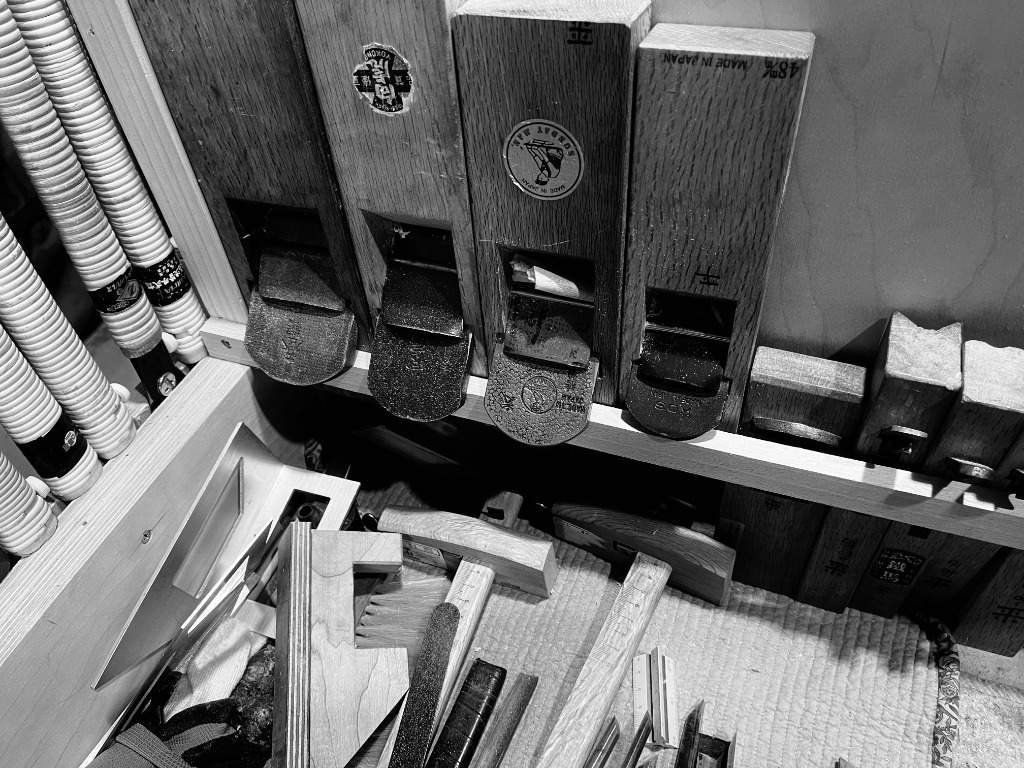
There are several hand planes on my workbench. Every one of them is a Japanese plane. I don't own a single Joseon-style plane. And it's not just me. You can safely say that, right now, in this country, there isn't a single carpenter joining changho who works with a Joseon-style plane. A Joseon-style plane cut by pushing. We now cut by pulling. Japanese planes arrived during the colonial period, and carpenters switched. It wasn't just swapping out one tool. Change the direction you cut, and your stance changes, and the path force travels through your body changes. The whole body changed.
Did the carpenters of that time agonize over it all night? Wondering, "will using this damage tradition?" I don't think so. It's not that they didn't think about it — that kind of concern couldn't even exist yet, because the word "tradition" hadn't arrived on the job site. A tool was simply something you used if it was good. If it cut well, you used it; if it didn't, you discarded it. The one question a carpenter asks a tool, then and now, has always been the same: does it cut well? Up to here, there's no problem at all. The problem happens next.
The changho those very carpenters built are, today, the "original form." They get designated as cultural properties, become the reference point for tradition, become objects that must not differ by so much as a fraction of an inch — changho cut with a Japanese plane. So here's what we're actually doing right now. We enshrine, as the original form, the work of people who simply picked up a new tool the moment they saw one, and we tell the carpenter who picks up a new tool today that they're damaging tradition. If that sentence doesn't sound strange to you, that's the stranger thing.
Where did this get tangled? I'd say it's the moment of designation. In the previous piece, I gave the name traditionalism to the attitude that freezes the pattern. Designation is that attitude's institutional form. When an individual does it, it stays an attitude; when the state does it, it becomes a principle. To designate something as tradition, you have to stop it in its tracks. You have to seize some point in time, some form, and draw a line: "up to here is the original form."
But changho have never once stopped. A Goryeo-era changho is different from an early-Joseon changho, which is different from a late-Joseon changho. Lattice proportions changed with each commission; tools changed the moment a better one came along; joinery changed as it passed from hand to hand. The instant you seize a single day out of that long flow and call it the original form, the hundreds of years before and after it are erased. What was flowing stops.
I don't want to use the word "taxidermy" carelessly, but here it isn't a metaphor — it's an accurate description. In an earlier piece, I wrote that a living thing can't be frozen. That's true. Which is exactly why the order of operations is frightening. To freeze something, you have to kill it first. Taxidermy keeps the hide and discards the living thing. Designation does exactly the same. It keeps the form and discards the attitude. The real substance a Joseon carpenter left behind wasn't the proportion of a tti-sal door — it was the attitude of picking up whatever was good when they saw it — and designation, in the name of preserving the proportion, bans that very attitude. It keeps the hide by discarding the living thing.
There are broadly three disputes that come up on the job. The design dispute, that it isn't tradition unless the proportions are exactly the old ones. The tool dispute, that it isn't tradition unless it's made with the tools of that era. The original-form dispute, that it must stay exactly as it was at the point of designation. They look like three different fights, but they share one root: using a frozen point in time as the yardstick. And measured by that yardstick, do you know who fails first? The Joseon carpenter himself. Because that person never once stopped. He built differently from his own master, and he picked up a new tool the moment one arrived. Bring today's standard back to Joseon, and the very hand that created the "original form" becomes a destroyer of tradition.
Tradition is tradition because it's alive. Being alive means changing. But designation doesn't know how to handle something alive. The only thing designation knows how to do is stop it in its tracks. And so this paradox holds: the instant something is designated as tradition, it stops being tradition.
There's proof this isn't just my own stubborn argument. The side doing the designating backed down first. And what made them back down wasn't a scholar's counter-argument — it was a single song. Arirang. Arirang has no original form. Its lyrics were never fixed, so it's a song reborn fresh with every singer and every day it's sung. It's practically a textbook example of something alive. But under the old law, this song couldn't be designated a cultural property. Designation requires naming a holder — but who do you name as the holder of a song the entire nation sings? You have to seize an original form — but which version of a song that changes every time it's sung do you seize? Not a single tool the half-century-old system possessed actually fit.
So they amended the law. In 2015, Arirang was designated without a holder. The Intangible Cultural Heritage Act that took effect the following year dropped the phrase "maintain the original form" that had been held onto for half a century, and replaced it with "maintain the jeonhyeong (典型, exemplary type)." There was no announcement, no apology. A single word was quietly swapped out in the text of the law. From then on, designations that named neither a holder nor an original form kept increasing. Ssireum (Korean wrestling) was designated that way. So was kimchi-making, ondol floor heating, jang (fermented sauce) making.
Why did they back down? Because they hit a wall.
The side that had spent half a century doing the designating was the first to learn, better than anyone, that the more you hold something living up against the yardstick of "original form," the more tangled it gets. A designation that names no holder and fixes no original form is, in other words, a declaration: we will designate, but we will not taxidermy. That very struggle is a confession — that designation had, in fact, been taxidermy all along.
Of course, that doesn't mean the tangle is resolved. What exactly "jeonhyeong" means still isn't settled today. If it were something a change of wording could fix, it would never have gotten tangled in the first place. So the witness to this paradox isn't a carpenter like me. It's the very body that does the designating. I scrutinized, in an earlier piece, why the phrase "traditional changho" is so blurry — and it seems half the answer was here all along. From the moment that phrase was born, it was already stopping in its tracks whatever it pointed at. Of course it's blurry. A finger made to point at something alive freezes, every single time, whatever it points to.
I still join changho with a Japanese plane, today too. I sometimes wonder what a Joseon carpenter would say, looking at my workbench right now.
I don't think he'd scold me for not using the old tools.
Because the plane in my hand is itself proof that those people were never the kind of people who would.
Source
- Act on the Safeguarding and Promotion of Intangible Cultural Heritage (Act No. 13248, enacted March 27, 2015, effective March 28, 2016), Article 3 — Korea Law Information Center, law.go.kr
- Kim Hong-do, "Thatching a Roof with Tile (葺瓦)," Danwon's Album of Genre Paintings — National Museum of Korea (a primary source depicting a push-type Joseon-style plane)
- Cultural Heritage Administration press release, "'Arirang,' Song of the Nation, Designated a National Intangible Cultural Heritage" (2015) — Korea Heritage Service website, cha.go.kr
- National Folk Museum of Korea, Encyclopedia of Korean Folk Culture (Dictionary of Korean Clothing, Food, and Shelter), entry "Plane (대패)" — folkency.nfm.go.kr
Browse the pattern designs in Pyeongmok Studio
Go to the Collection