
Mili Isn't a Water Channel
This series · A Second Look · No. 7 (8 episodes total) Ongoing
"The more firmly something has set, the more it deserves a second look."
- No. 1 Sotgeul-chang or Soseul-chang | The Correct Spelling and Its Origin
- No. 2 The Dokkaebi Has No Horns
- No. 3 Traditional Changho | Why Is This Term So Blurry?
- No. 4 Traditional Changho | Must It Be Built Exactly as the Ancestors Built It?
- No. 5 Traditional Changho | My Hand Plane Is a Japanese Plane
- No. 6 Manja-sal and Man-sal Are Different Changho
- No. 7 Mili Isn't a Water Channel
- No. 8 Jang Gi-in's Changho | Where It Comes Apart
Originally written in Korean by the author. Translated with the help of AI. Read the original
You are free to quote and excerpt posts and records from the Pyeongmok blog, as long as you credit the source (pyeongmok.com).
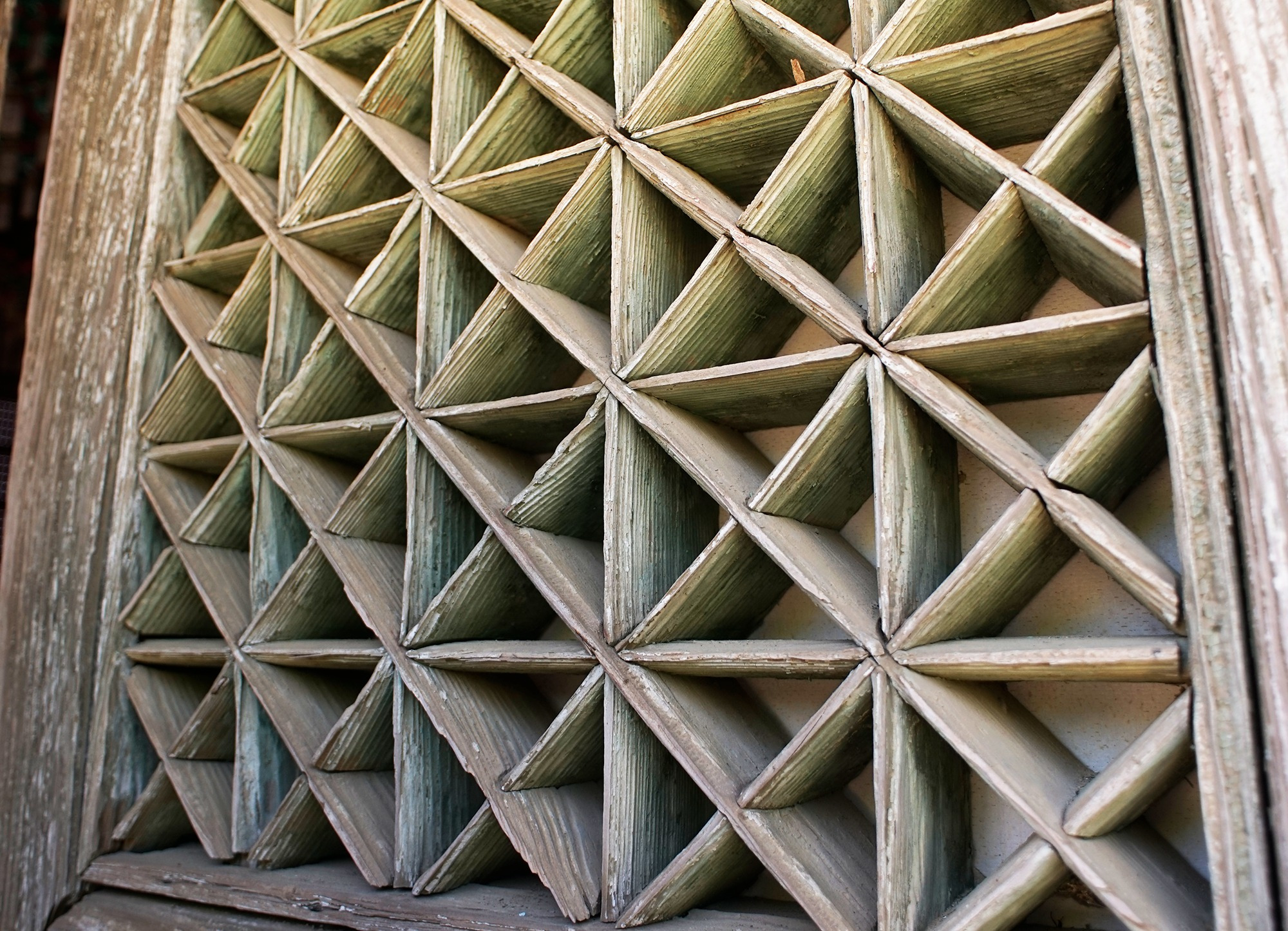
Mili Isn't a Water Channel
I'd Been Turning This Over for a Long Time
Cutting a mili (a decorative moulding planed along the slat face) profile into a slat's face is no small amount of labor.
Putting in this much work had to have a reason, and I couldn't find it. The thought came back to me every time I looked at it while joining.
I'd heard it was about rainwater. It sounded plausible.
Why It Sounded Plausible
Take dumili ("double mili") as an example. Two grooves are cut into the slat's face, with a single ridge standing between them.
Read it as a path for water to travel, and it fits.
The ridge cuts the water off. Water on a wood surface tends to spread sideways, and when it hits a raised spot, it can't cross over.
The groove gathers it. Water that's split off drops into the groove and flows downward.
Where a vertical slat meets a horizontal one, there's a gap. No matter how precisely you join it, some gap remains — about the thickness of a saw blade. Water sitting in a horizontal groove crosses over into the vertical groove through this gap.
And we apply the changho paper on the inside. The slat stands in front, the paper is attached behind it. If water spreads sideways across the slat's face and rounds the corner, it reaches the spot where the paper is glued. Wood dries out, but paper doesn't come back.
A device that keeps water from ever reaching the paper. Read it that way, and everything gets explained.
The Cost Is Not Small
Dumili doesn't end with just planing a groove.
Cut the groove, and the slat's "neck" ends up thinner than its "head." For two slats to meet, this head has to pass through the other slat, but since the head is thick, it won't fit through.
So the head is trimmed down to the width the neck can pass through. At every single crossing point.
A hand plane can't reach in here. You bring in a saw. You cut it out with a chisel. You file it smooth.
It's a small spot. But get it wrong, and the slat snaps. Sometimes it twists. A snapped slat is thrown away.
The cross-section shrinks, too. By my own reckoning, if a plain slat is 100, something like ten-odd percent gets cut away. And it happens to be the shoulders on either side of the head that disappear — exactly the spot that resists the most when a slat bends under wind pressure.
What do you actually get for paying that price? That was the substance of what I'd been turning over.
My Teacher Had Already Let This Go
Earlier this month, I visited my teacher in Daegu. I brought up the idea that the dumili groove is a rainwater channel.
He said there's no such account in the literature. That it sounded like something invented later.
I looked. There wasn't.
Even so, I couldn't quite let it go. There's something I know in my hands — was it really something to discard just because there's no text for it?
Where It Flips
Four places.
One. Japan not having this isn't about rain.
Japanese shoji have no moulding at all, neither on the frame nor on the slats. I'd assumed that was simply because shoji is an interior fitting that never gets wet.
But there was a separate reason. Japan applies the paper to the outer face of the slats. That face is the one the paper is glued to. Cut a groove there, and the paper lifts off the surface. Which is why Japanese fittings, if anything, plane that face flatter still, to make it a better surface for the paper to sit on.
Wet or not, it was a face that simply couldn't be grooved. It wasn't corroborating evidence at all.
Two. There are too many kinds.
Just for edge-rounding alone, there's silmo, minbitmo, teokbitmo, dungeun-teokbitmo, dungeunmo, oesamo, ssangsamo, teok-dungeunmo. There's a separate set of face-profiles cut into the surface, too. The slat has its own moulding, and the frame has its own moulding again.
If the purpose were draining water, one profile that drains well would be enough.
Function doesn't produce this many variations. This is a repertoire.
Three. Even a convex slat has a name.
It isn't only concave profiles. A slat whose surface bulges out slightly convex has its own separate name: jangpi-sal.
A concave profile gathers water. A convex face does the opposite — it sheds water off to both sides, toward the corners.
Right in the middle of a family supposedly built for channeling water, there's one that sheds it instead, and it even has a name sitting right there.
Four. Every single name describes a shape.
Gol-mili, bae-mili, deung-mili, du-mili. Silmo, dungeunmo, bitmo.
Every one of them is a name taken from what it looks like. Not a single one is a name that points to a function.
Oesa and ssangsa attach both to faces and to corners — there's a separate oesa-face-profile and a separate oesa-corner-profile. "Sa" (絲, "thread") isn't a location, it's a count of lines. One line is oesa, two lines is ssangsa. If it were a water channel, the location would have to be fixed — but all that's being counted here is quantity.
And I found something written down, too. In a document laying out how to build beomsal-changho, it says: "the slat's back is given moulding to add shape."
It says, in plain writing, to add shape. I was the only one looking for something else.
It Differs from Person to Person
There's no fixed value for how to shape a dumili head.
I have my own rule for it, and looking at work joined elsewhere, it differs slightly, piece to piece. Some are round; some are egg-shaped.
Round or egg-shaped, it makes no difference to water. Both have a convex head with an undercut, and water is cut off exactly the same way either way.
The only difference is to the eye.
If water were what decided this, there'd be no reason for it to diverge here at all. If there's a minimum needed to cut off water, everyone would converge around that same minimum — fall short, and it fails; go past it, and all you do is weaken the slat for nothing.
The fact that it diverged means there was no standard to match in the first place.
When You Sharpen the Blade
There's a spot where that shape actually gets decided. It's when you sharpen the mili plane's blade. The blade's shape gets stamped straight onto the slat.
Whether to grind it round or egg-shaped, where to break the shoulder — that's decided right there.
Looking back on what I was thinking at that moment, all I was thinking about was making it look good.
I never once thought about water.
Though This Is Only Today's Story
What I can speak to only goes as far as what's happened in my own hands.
It's common enough for a function to become a habit, and for a habit to be left behind as pure form. Lay that path out, and everything I found today gets explained. Once the function is forgotten, variation becomes free, so the number of types grows; since only the shape remains, the name gets attached to the shape too; and since the constraint is gone, it differs from person to person.
One remaining detail points the same direction. Interior doors don't bother cutting mili. It's possible to, and some interior doors do — but there's no real need to. The same goes for the daecheong-facing doors.
If shape alone were the point, the interior is exactly where you'd want it — it's the face a person sits and looks at all day long. And yet it clusters on the side that faces the rain.
The placement itself still seems to remember something.
Which means both my teacher's guess that it's a later invention, and what I'd heard, can both be true at once. A trace survived as a story.
So
Here's how I'll settle what I'd been turning over for so long.
Why mili has the shape it has today can't be explained by water. At least, not in my own hands.
Whether it wasn't true at the very start either, I don't know. That's not something today's findings can reach.
I thought the reason I was looking for was out there somewhere. It was in my own hand, sharpening the blade.
Browse the pattern designs in Pyeongmok Studio
Go to the Collection