
The Dokkaebi Has No Horns
This series · A Second Look · No. 2 (8 episodes total) Ongoing
"The more firmly something has set, the more it deserves a second look."
- No. 1 Sotgeul-chang or Soseul-chang | The Correct Spelling and Its Origin
- No. 2 The Dokkaebi Has No Horns
- No. 3 Traditional Changho | Why Is This Term So Blurry?
- No. 4 Traditional Changho | Must It Be Built Exactly as the Ancestors Built It?
- No. 5 Traditional Changho | My Hand Plane Is a Japanese Plane
- No. 6 Manja-sal and Man-sal Are Different Changho
- No. 7 Mili Isn't a Water Channel
- No. 8 Jang Gi-in's Changho | Where It Comes Apart
Originally written in Korean by the author. Translated with the help of AI. Read the original
You are free to quote and excerpt posts and records from the Pyeongmok blog, as long as you credit the source (pyeongmok.com).
Picture a dokkaebi. Does it have horns, a tiger-skin wrap, and a spiked iron club in its hand?
That isn't a dokkaebi. It's Japan's oni (鬼).
In Part 1, we saw how pronunciation reshapes spelling, and how spelling then erases meaning.
This time, it's a bigger story.
A hundred-year record of translation swapping out an entire being.
A Spirit Without a Fixed Form
In our own texts and folktales, the dokkaebi has no fixed face. A dokkaebi exists through its behavior, not its appearance. It challenges you to a wrestling match on a night road, loves buckwheat jelly, builds a bridge overnight, plays mischievous pranks and then turns around and brings you wealth. What folklore studies identify as the dokkaebi's true nature isn't a monster — it's a being that brings good fortune. Even the origin story that a dokkaebi is an old broom, straw shoe, or broken pestle — an object worn by human hands — come alive at night, tells you this being lived right alongside human life.
No horns, no tiger skin, no iron club appear anywhere in this tradition.
The evidence is right there in our own language. Dokkaebi-janggan (dokkaebi mischief), dokkaebi-sijang (a "dokkaebi market," meaning a chaotic pop-up market), dokkaebi-bul (will-o'-the-wisp), "dokkaebi ssinarak kkanmeoneun sori" (nonsensical mumbling, literally "a dokkaebi munching on seed rice"). Every single expression built around "dokkaebi" carries the same texture: absurdity, unpredictability, something that pops up out of nowhere and vanishes again. Language is a record of the emotions of the people who used it. Korean has never once feared the dokkaebi.
The True Owner of the Horns, the Tiger Skin, and the Iron Club
That form belongs to someone else entirely. Japan's oni — a hellish jailer and a monstrous, man-eating force, a calamity that raids villages. The widely circulated explanation in Japan for the horns and tiger skin is directional: since the kimon (鬼門, the "demon gate," the direction spirits are said to pass through) points toward ushitora (丑寅) — the direction of the ox and the tiger — the oni came to wear an ox's horns and wrap itself in a tiger's hide. Even the spiked iron club it carries, the kanabō (金棒), traces back to this. Every element of the standard iconography we know as "dokkaebi" came from here.
Just look at the club alone, and the distance between the two beings becomes clear. The dokkaebi bangmangi (dokkaebi club) produces gold and treasure when you strike it. The kanabō smashes things to pieces. The same object — a club — yet one is a tool of production and the other a weapon of violence. These two became a single image. How? That's the question this piece asks.
The Temperature of the Word "Oni"
The Japanese language itself testifies to why this confusion isn't just a matter of a picture. "Oni" is a root word that's still alive and active in Japanese today. A frightening wife is an oni-yome (鬼嫁); a brutal superior is an oni-gunsō (鬼軍曹). Steeling your heart to be merciless is called "turning your heart into an oni" (心を鬼にする) — the very act of cutting off mercy is what it means to become an oni. Someone obsessed with work is a shigoto no oni (仕事の鬼, "work demon"), and in current slang, oni (鬼) functions as a superlative prefix meaning something like "insanely." Every year, on the day before Risshun, households across Japan throw beans and shout: Oni wa soto (鬼は外) — "Oni, get out." Momotarō sets off to conquer the oni, and the game of tag is called oni-gokko (鬼ごっこ) — the "it" player is literally the oni. The sense of "something you must not be caught by" is carved even into the name of a national children's game.
Now set them side by side. On one side, a fear you drive out by throwing beans. On the
other, a neighbor who wrestles with you all night and shares buckwheat jelly.
Two beings whose emotional temperature splits this sharply don't end up sharing the same name and the same image through ordinary cultural exchange.
The oni, of course, has other faces too. Extraordinary talent is called kisai (鬼才, "demon genius"), and there's even a children's story about a red oni who cries because it wants to be friends with humans.
A being layered with both reverence and fear — that's the oni's full face. So the problem was never the oni itself. It's the path by which the oni came to live under someone else's name.
The Route of the Transplant
Stories crossing borders is, in itself, nothing new. In the mid-Joseon period, Gang Hang recorded in his Sueunrok a tale he'd heard in Japan, "Yugye (瘤戒)" — a story nearly identical to our own "Old Man with the Lump."
Folktales naturally cross borders.
That, in itself, is no crime.
The problem wasn't the story. It was the system.
In 1910, "Yuchwi (瘤取)" was introduced in Takahashi Toru's Chosen no Monogatarishu. In 1915, "The Old Man with the Lump" was included in the Government-General of Korea's Elementary School Korean Language and Classical Chinese Reader — material the Government-General had lifted directly from the Japanese textbook Jinjō Shōgaku Dokuhon. Why this story, of all stories? Because of Ilseon-dongjoron, the theory claiming Korea and Japan shared a common ancestry — the Government-General needed a folktale that fit that script.
The history of the illustrations is telling. In the 1915 edition, there's no image of a dokkaebi at all — only the old man with the lump is drawn. The horned oni-shaped figure only entered the dokkaebi's place from a later revised edition onward. The story arrived first, the image followed, and thirty years of textbooks taught Korean children that image was the dokkaebi. A textbook reshapes an entire generation's eyes. By the time liberation came, the horned dokkaebi had already become "our own."
Taking Root, and Amplifying
After that, we drew it ourselves. Picture books of traditional folktales, classroom bulletin boards, and comics all reproduced the horned dokkaebi. In 2007, an elementary Korean-language textbook's dokkaebi illustration was corrected after criticism that it was, in fact, an oni; the same controversy repeated itself in a 2016 elementary English textbook. A hundred years later, textbooks are still drawing the very image a textbook planted a hundred years before.
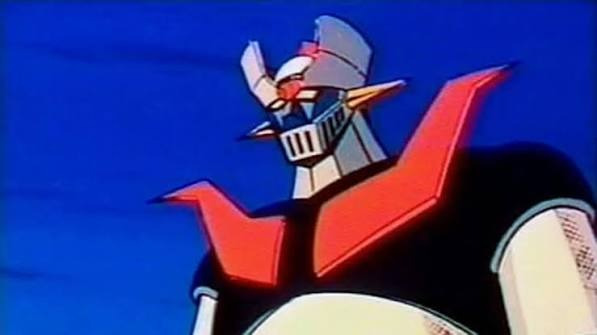
Japanese pop culture layered even more on top of this. Even the name Mazinger Z, from 1972, is a blend of kikai (機械, "machine") and majin (魔神, "demon god"). The original name, "Energa Z," was swapped out for lacking impact — and the work's own premise was a power that "could become either a god or a devil." The dual nature of the oni lineage, wearing the body of a robot. Half a century later, Demon Slayer (鬼滅の刃) swept the world with a story about cutting down oni.
Japan's imagination cuts down the oni even as it borrows the oni's power. Every time that culture was imported, another layer of the horned figure's image piled onto the name "dokkaebi," and by the time of the 2016 drama Goblin (도깨비), that name was pointing at a being with no relation at all to its original owner.
Reclaiming the Name
The dokkaebi has no horns. The horns, the tiger skin, and the iron club belong to the oni. That image rode in through the Government-General's textbooks and lived under the dokkaebi's name for a hundred years. A being stripped of its name is stripped of its image, and a being stripped of its image is stripped of its own place.
The dokkaebi wasn't the only one hurt. The fierce face carved into old door handles and roof tiles — the face we've been calling the "dokkaebi tile" — also lost its true identity in this same confusion. Folklorist Kim Jong-dae's verdict is unambiguous.
Calling gwimyeon tiles "dokkaebi tiles" is a mistake, and the dokkaebi does not possess the byeoksa power that a gwimyeon tile performs. So then — who is that face, really?
That story continues in Yogwe, Dokkaebi, and Chiyu, the Heavenly King (Ward Off, Call Forth, No. 3).
When pronunciation reshapes spelling, meaning gets erased. When translation reshapes an image, a being gets erased. There's only one way to reclaim it: go back to the record and confirm the original face. That's why this blog keeps recording, one piece of lattice, one name, at a time.
Source
- Gang Hang, Sueunrok (睡隱錄), "Yugye (瘤戒)"
- Takahashi Toru, Chosen no Monogatarishu (朝鮮の物語集附俚諺), "Yuchwi (瘤取)," Ilhan Seobang, 1910
- Government-General of Korea, Botong Hakgyo Joseoneo-geup-Hanmun Dokbon (1915)
- Heo Ryeon, from Chaessi Hyohaengdo, "Guihwajeondo (鬼火前導)"
- "The Tale of the Old Man with the Lump" ("Hokburi Yeonggam Seolhwa"), Encyclopedia of Korean Culture
- Kim Jong-dae, "Understanding the Dokkaebi We Think We Know Well, But Don't," Korea Heritage Service, Monthly Magazine Loving Our National Heritage
Browse the pattern designs in Pyeongmok Studio
Go to the Collection