
Se-sal (細살) | A Changho Set with Fine Slats, Packed Close
This series · The Changho Glossary · No. 2 (14 episodes total) Ongoing
"Sorting out the names and joinery of traditional changho, one at a time."
- No. 1 Jeongja-sal | A Changho Joined into the Character 井
- No. 2 Se-sal (細살) | A Changho Set with Fine Slats, Packed Close
- No. 3 Bit-sal | A Changho Joined with Slats Set on the Diagonal
- No. 4 Aja-sal | A Pattern With No Good Meaning
- No. 5 Wanja-sal | A Pattern Overflowing with Meaning
- No. 6 Sutdae-sal | A Changho Joined with Broken Slats
- No. 7 Semo-sotgeul-sal | A Changho Where the Cells Come Out as Triangles
- No. 8 Yukmo-sotgeul-sal | A Changho Where the Cells Come Out as Hexagons
- No. 9 Gyeokja-bit-sal | A Changho Layering Diagonal Lattice Over a Grid
- No. 10 Gwigap-sal | Tenon or Notch?
- No. 11 Yongja-sal | A Jeongja-sal Scaled Up
- No. 12 Changho Hung in Layers | Ssangchang, Yeongchang, Heukchang, Gapchang
- No. 13 Changho Built into the Wall | Bongchang, Salchang, Gwangchang, Deulchang
- No. 14 Small Changho | Baraji, Nukkup, Changgyeong
Originally written in Korean by the author. Translated with the help of AI. Read the original
You are free to quote and excerpt posts and records from the Pyeongmok blog, as long as you credit the source (pyeongmok.com).
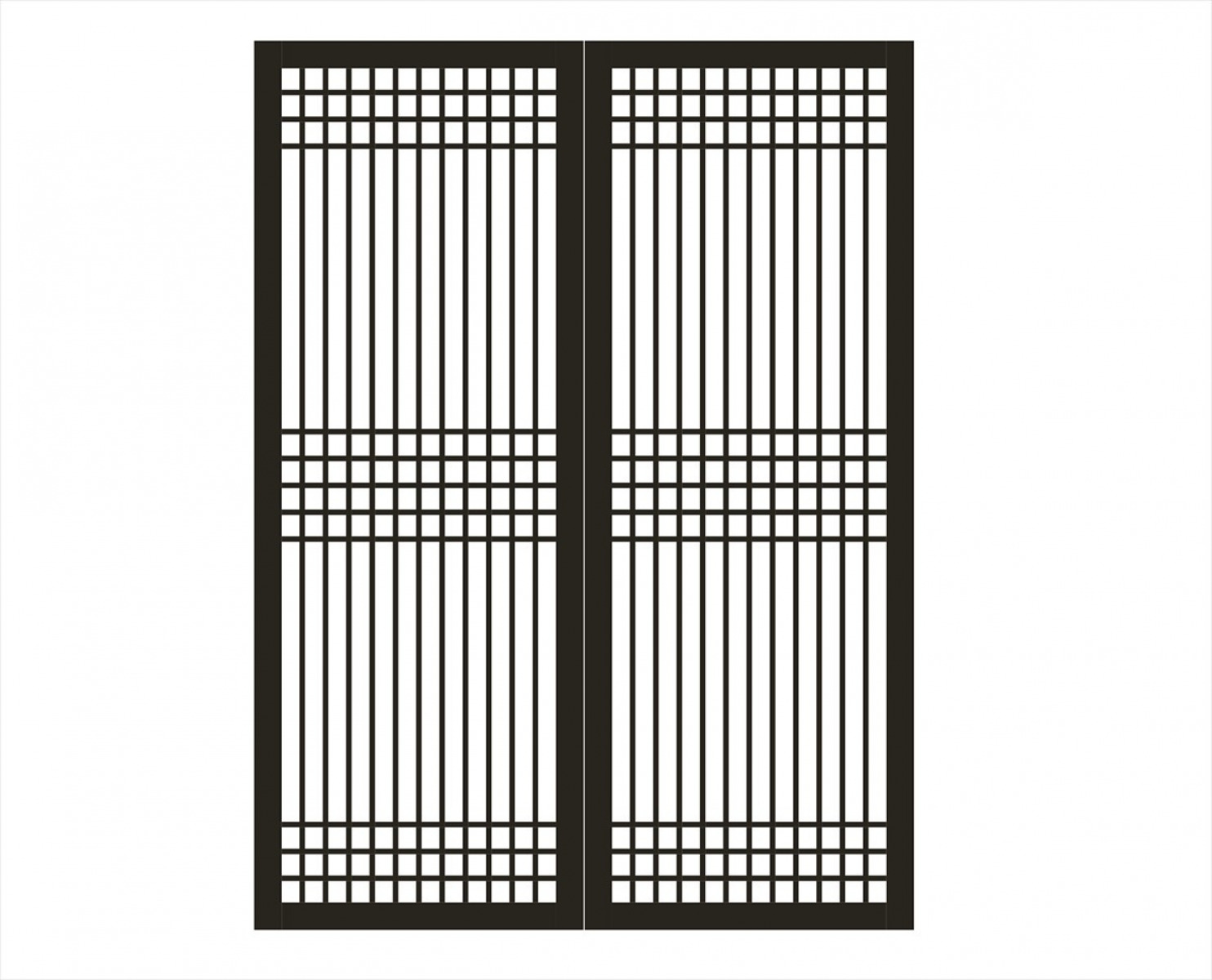
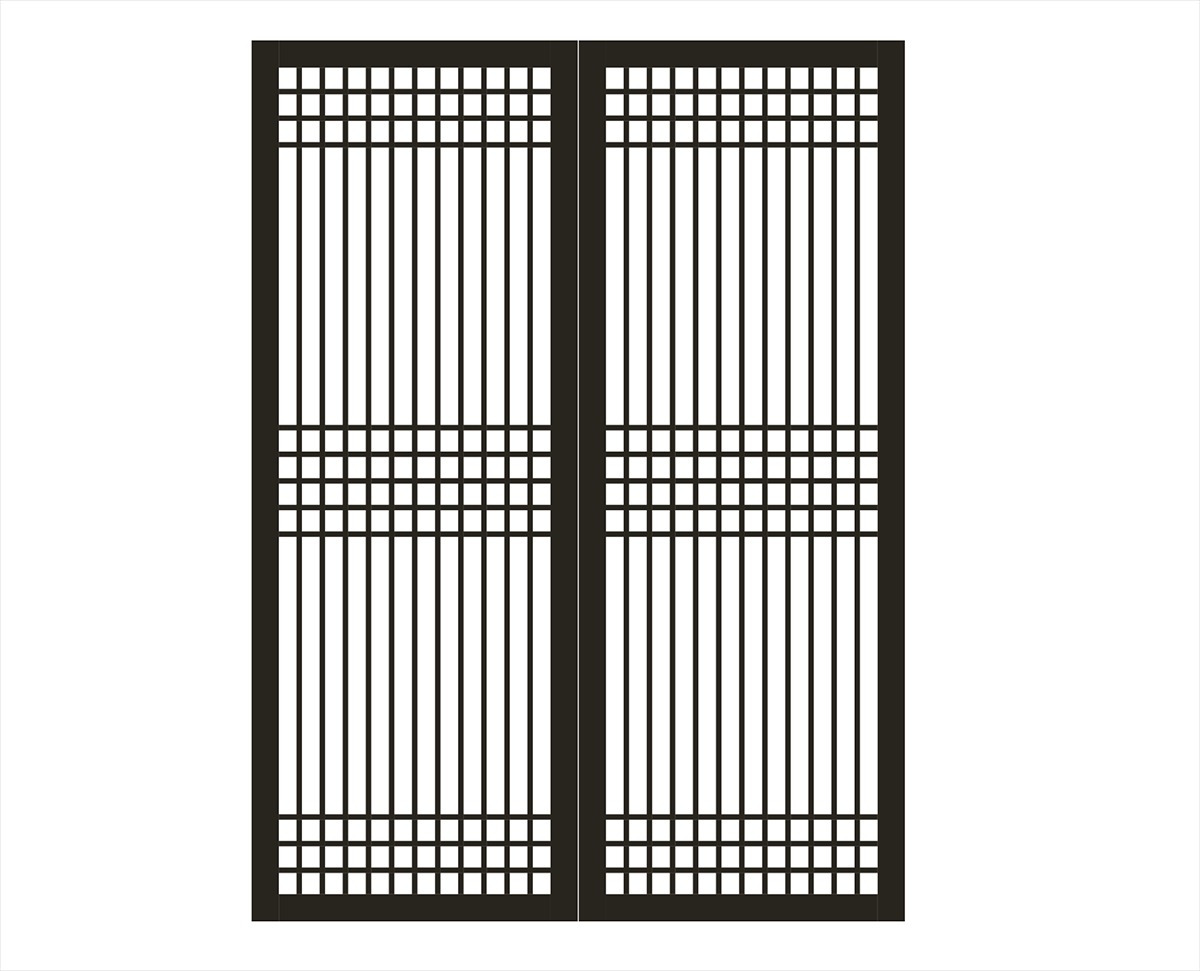
Se-sal is a changho built by standing vertical slats close together, while the horizontal slats are bundled in small groups at three levels — top, middle, and bottom.
It was the most widely used of all lattice joineries, hung everywhere from ordinary home doors to temple halls and palaces.
The Name
It's called se-sal (細살, "fine lattice") because the slats are thin. The same changho is also called tti-sal (帶살, "band lattice") — a name based on how the horizontal slats look bundled in like a band.
The two names don't point to two different changho. One was coined by looking at the vertical slats, the other by looking at the horizontal ones.
They're simply naming the same changho from a different angle.
An explanation circulates that "se" here means "three," because the horizontal slats bundle in at three levels. It sounds plausible, but the slats going into those spots aren't three in number. The default is 5-7-5, ranging from 3-5-3 up to 6-8-6 depending on the door's height. What comes in threes isn't the slats — it's the bundles.
And there's already a separate name for the bundles: tti-sal.
If jeongja-sal, wanja-sal, and aja-sal are names that write out the shape of a character — 井, 卍, 亞 — then se-sal and tti-sal are names that simply describe how the slats themselves look.
It's the same naming logic as gol-mili, bae-mili, and deung-mili, names taken from the shape into which a slat's face has been planed.
The Joinery
Where a horizontal slat meets a vertical one, a half-lap notch is cut into each. Remove half the material from each and fit them together, and the two slats' outer faces line up flush as a single plane.
The technique is the same as jeongja-sal.
What's unique to se-sal is how many horizontal slats are bundled together at once. The count isn't arbitrary.
The default is 5-7-5: five on top, seven in the middle, five on the bottom. It moves up or down a set series depending on the door's height.
3-5-3, 4-6-4, 5-7-5, 6-8-6. Four rows where the top and bottom match, and the middle is always two more.
There are two rules. The top and bottom match. The middle has two more. Even as the door's height moves up or down, these two rules are never touched — instead, you just move up or down one row.
So when sizing a given door, what you decide isn't the number of horizontal slats — it's which row of the series to use. The count follows automatically once the row is chosen.
Odd numbers were mostly used, though some were joined with even numbers too. With an odd number, the very center slat of the middle bundle lands exactly at the center of the door — the 5 in 3-5-3, the 7 in 5-7-5. An even number splits perfectly in half with no center slat, while an odd number sets its center on a single slat and balances evenly to both sides.
The horizontal slats are fitted into the frame with short tenons. On a large door, sometimes only the single center slat is given a longer tenon — that one slat adding extra strength on its own.
My own guess is that the old notion of odd numbers as yang (陽) numbers is layered in here too. Odd numbers show up throughout traditional architecture —
setting a building's front bay count at 3, 5, or 7 bays is the same idea. That said, changho joined with even numbers survive as well, so whether this comes from the idea or is simply a byproduct of the joinery itself still can't be settled.
I'll take that up separately in a piece on gilsang (auspicious symbolism).
Because the vertical slats are packed close and the horizontal slats come in only these few groups, a single horizontal slat needs several half-lap notches cut into it in a row.
If the division is off by even a little, that error piles up at the end cell. This is a changho where dividing matters more than cutting.
This is exactly why se-sal became the most widely used pattern. Holding up the changho paper and dividing the light is the vertical slats' job.
The horizontal slats' role is simply to keep those verticals from bowing, so they're bundled in only where needed.
Weave both directions equally tight, and you need that much more wood, and that much more notching. Se-sal is a changho that strips the horizontal down from exactly that point.
A single door stands on the least wood and the least labor.
The Proportion of a Cell
Wherever the horizontal slats bundle in, a grid forms just like jeongja-sal's. This cell isn't a perfect square. The vertical is set a little longer.
That's because a perfect square actually ends up looking like it's spreading sideways. The proportion changes again as the door gets bigger, and it also differs from hand to hand.
It's not something a ruler settles — it's something the eye settles.
How many vertical slats to stand also comes out of this. It isn't a value fixed in advance and plugged in.
You set it so this cell comes out as a good-looking rectangle for the door's size, and the count follows from that result.
The door's height decides the horizontal slats; the shape of the cell decides the vertical ones.
→ Covered in detail in "The Eye Gets Fooled" (What the Eye Does, What the Mind Does, No. 1). (link)
Where It Was Used
It was used widely — on the room doors and main hall doors of ordinary homes, on temple hall doors, and in palaces. Changho with a heavier count of horizontal slats are mostly found in palace halls.
Its use varied by the standing of the house. In the homes of the sadaebu (scholar-official class) and jungin, it was hung as an outer layer over a room's inner changho; in commoners' homes, it was often the only layer, used directly as the entrance door.
That makes sense — it was a changho that could stand a door with the least material of all. A configuration hanging se-sal on the inside with a jeongja-sal outer layer is common too.
It's the simplest of all lattices, and yet the story ran long.
Once it's all joined, it looks like nothing more than a few vertical slats and a few rows of horizontal ones — but there's this much to decide before you ever get there.
Source
- Ju Nam-cheol, Doors and Changho (2001)
- National Institute of Korean Language, Standard Korean Dictionary, entries "se-sal-mun" and "tti-sal-mun"
Browse the pattern designs in Pyeongmok Studio
Go to the Collection