
Sutdae-sal | A Changho Joined with Broken Slats
This series · The Changho Glossary · No. 6 (14 episodes total) Ongoing
"Sorting out the names and joinery of traditional changho, one at a time."
- No. 1 Jeongja-sal | A Changho Joined into the Character 井
- No. 2 Se-sal (細살) | A Changho Set with Fine Slats, Packed Close
- No. 3 Bit-sal | A Changho Joined with Slats Set on the Diagonal
- No. 4 Aja-sal | A Pattern With No Good Meaning
- No. 5 Wanja-sal | A Pattern Overflowing with Meaning
- No. 6 Sutdae-sal | A Changho Joined with Broken Slats
- No. 7 Semo-sotgeul-sal | A Changho Where the Cells Come Out as Triangles
- No. 8 Yukmo-sotgeul-sal | A Changho Where the Cells Come Out as Hexagons
- No. 9 Gyeokja-bit-sal | A Changho Layering Diagonal Lattice Over a Grid
- No. 10 Gwigap-sal | Tenon or Notch?
- No. 11 Yongja-sal | A Jeongja-sal Scaled Up
- No. 12 Changho Hung in Layers | Ssangchang, Yeongchang, Heukchang, Gapchang
- No. 13 Changho Built into the Wall | Bongchang, Salchang, Gwangchang, Deulchang
- No. 14 Small Changho | Baraji, Nukkup, Changgyeong
Originally written in Korean by the author. Translated with the help of AI. Read the original
You are free to quote and excerpt posts and records from the Pyeongmok blog, as long as you credit the source (pyeongmok.com).
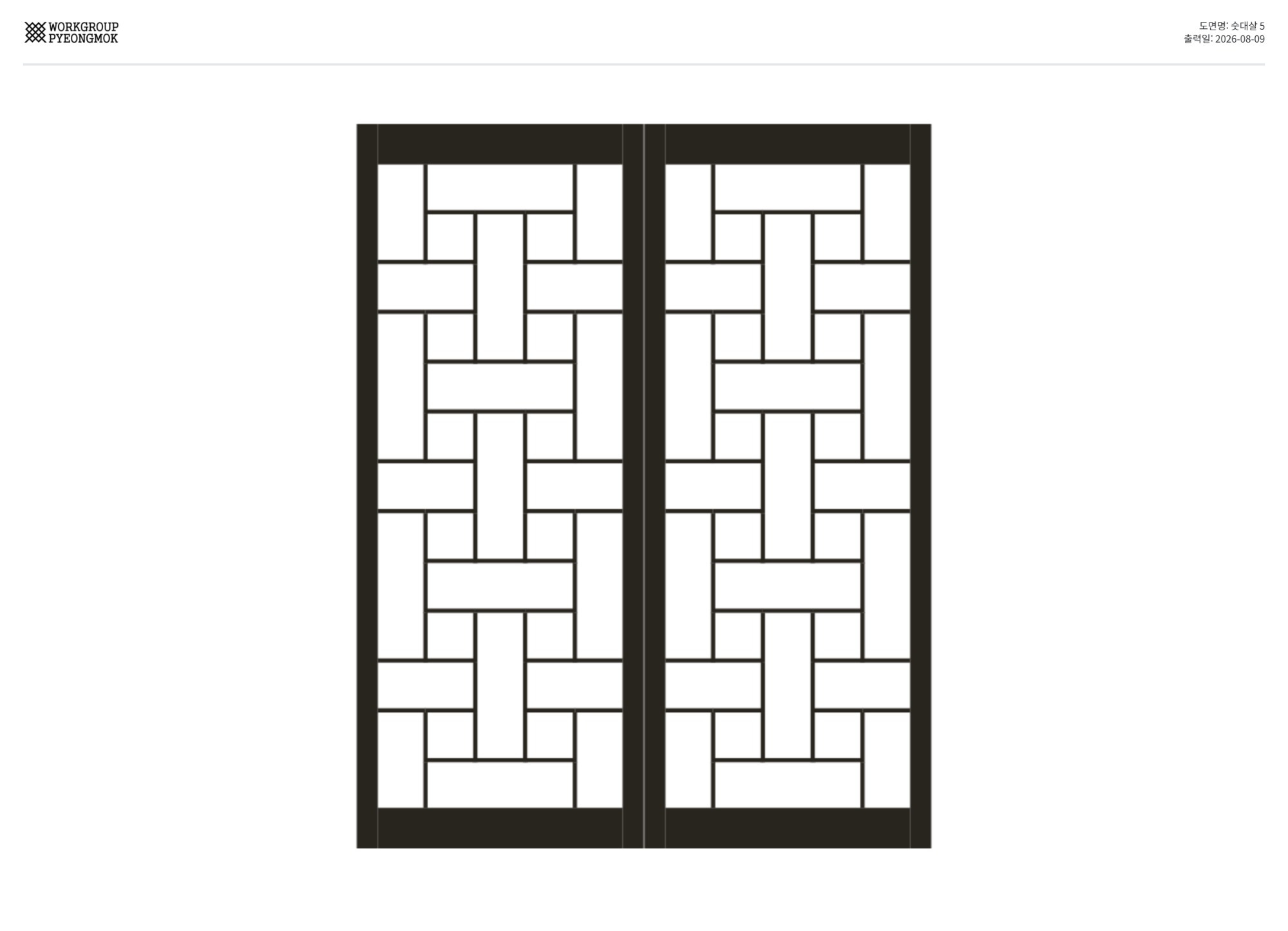
Sutdae-sal | A Changho Joined with Broken Slats
The name comes from sangaji — counting rods used for arithmetic. Made from bamboo, sorghum stalks, or twigs trimmed down to about the size of chopsticks, they were also called sandae or sanmok. Because the pattern looks like these rods laid out in a row, it's called sutdae-sal. It's also written jutdae-sal.
Sutdae-sal is a changho built by cutting the slats out of a jeongja-sal grid. That's the order you draw it in, at least.
First you set the grid. The horizontal slats go in odd numbers, the vertical slats in even numbers. The horizontal slats center the grid, and since the vertical count is even, the number of cells comes out odd.
Then you check the ratio of each cell's width to height. You adjust the slat count until that ratio comes out right.
Next, you cut. Usually two cells at a time. Since the cell count is odd, one cell is left over in each row, and as that leftover cell shifts position, the cut point shifts by one cell from row to row.
Cut it aligned straight down, and all you get is a jeongja-sal with bigger cells. It only becomes sutdae-sal once the cuts are offset — that's what lets a horizontal rectangle and a vertical rectangle interlock with each other.
That's sutdae-sal.
It was a changho used in the sarangbang, the men's quarters. It paired with wanja-sal in the anbang, the main inner room.
The joinery is a short tenon. This is where it splits from the others. In jeongja-sal, the slats run through as single continuous pieces and cross each other, so that spot is a half-lap.
Wanja-sal and aja-sal both use half-laps too. Only sutdae-sal is different. Since every slat is already broken into segments, there's no spot left to cross, so each segment is fitted in with a short tenon.
On paper, it's a changho subtracted from jeongja-sal, but the hand joins it differently. The order you draw it in and the order you join it in split apart. Even so, the foundation is still jeongja-sal.
Even now, I still draw the whole jeongja-sal grid out first, and only then cut pieces away.
For this changho, proportion is everything. The horizontal rectangle and the vertical rectangle — get that ratio right, and it feels open and pleasing; get it wrong, and it feels cramped.
I've joined it many times, but every time, I still start by working out that ratio. Which brings me back to the name. The explanation that it resembles sangaji rods laid out in a row is a common one.
But look at how sangaji were actually used to write numbers, and there's another layer to it.
The orientation changes with each digit's place. The ones, hundreds, and ten-thousands places were laid vertically; the tens, thousands, and hundred-thousands places were laid horizontally.
It's an object whose orientation flips every time the place value shifts — and this changho is one where the cut point shifts every time the row shifts. They overlap.
That said, there's no record that a carpenter actually knew this counting method and carried it over into the changho.
I'll leave it here, at just this much.
Source
- Encyclopedia of Korean Culture, entry "sangaji (counting rods)"
- National Institute of Korean Language, Standard Korean Dictionary, entry "sanmok"
Browse the pattern designs in Pyeongmok Studio
Go to the Collection