Changho Hung in Layers | Ssangchang, Yeongchang, Heukchang, Gapchang
This series · The Changho Glossary · No. 12 (14 episodes total) Ongoing
"Sorting out the names and joinery of traditional changho, one at a time."
- No. 1 Jeongja-sal | A Changho Joined into the Character 井
- No. 2 Se-sal (細살) | A Changho Set with Fine Slats, Packed Close
- No. 3 Bit-sal | A Changho Joined with Slats Set on the Diagonal
- No. 4 Aja-sal | A Pattern With No Good Meaning
- No. 5 Wanja-sal | A Pattern Overflowing with Meaning
- No. 6 Sutdae-sal | A Changho Joined with Broken Slats
- No. 7 Semo-sotgeul-sal | A Changho Where the Cells Come Out as Triangles
- No. 8 Yukmo-sotgeul-sal | A Changho Where the Cells Come Out as Hexagons
- No. 9 Gyeokja-bit-sal | A Changho Layering Diagonal Lattice Over a Grid
- No. 10 Gwigap-sal | Tenon or Notch?
- No. 11 Yongja-sal | A Jeongja-sal Scaled Up
- No. 12 Changho Hung in Layers | Ssangchang, Yeongchang, Heukchang, Gapchang
- No. 13 Changho Built into the Wall | Bongchang, Salchang, Gwangchang, Deulchang
- No. 14 Small Changho | Baraji, Nukkup, Changgyeong
Originally written in Korean by the author. Translated with the help of AI. Read the original
You are free to quote and excerpt posts and records from the Pyeongmok blog, as long as you credit the source (pyeongmok.com).
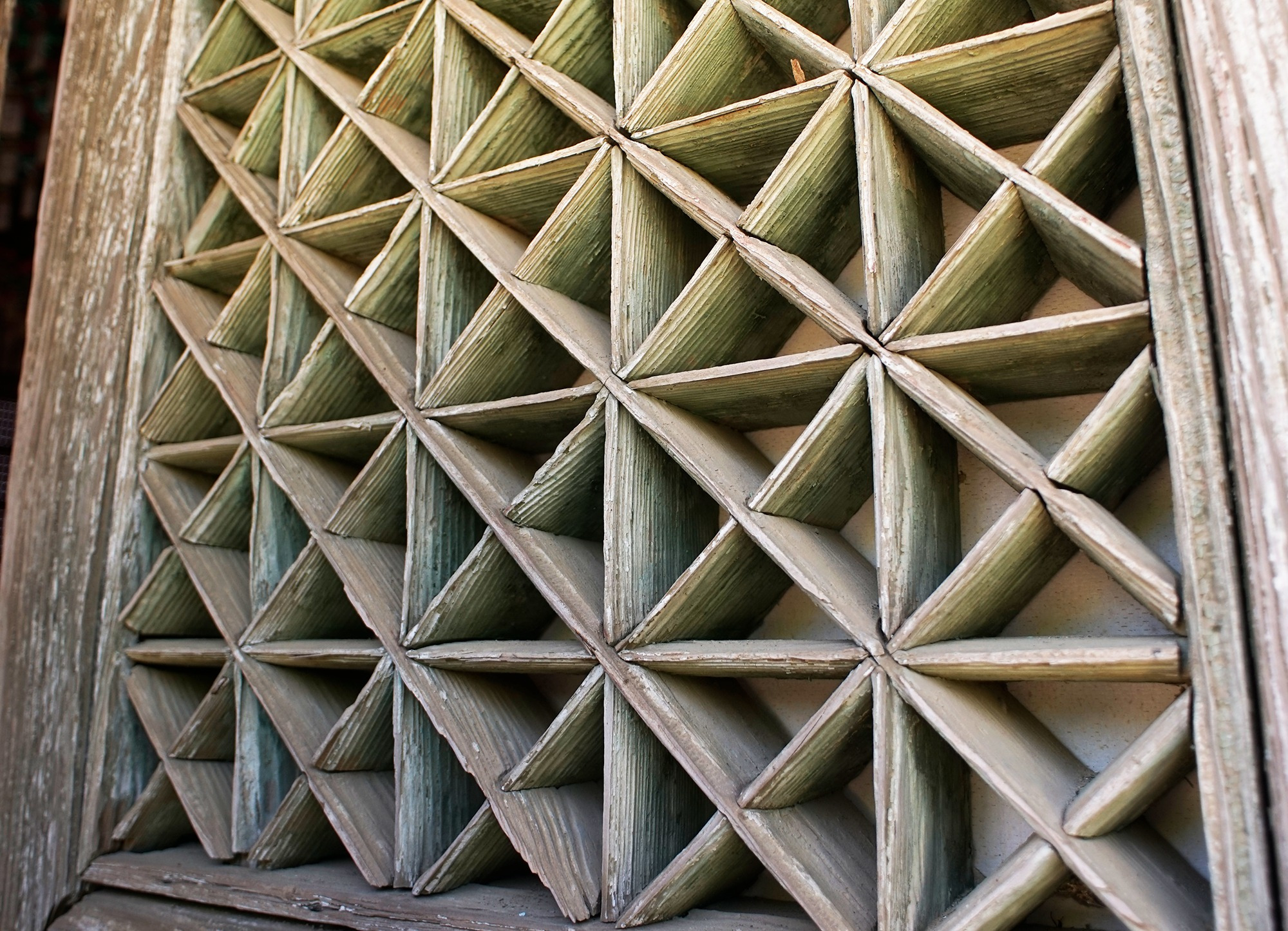
Changho Hung in Layers | Ssangchang, Yeongchang, Heukchang, Gapchang
An ondol room's front wall was never fitted with just a single layer of changho.
Several layers were hung one behind another, outside to inside. Not one changho — a whole cluster of them.
The Order of the Layers
In ordinary times, they're hung like this.
Ssangchang → yeongchang → (heukchang) → gapchang
In summer, it changes to this.
Ssangchang → sachang → gapchang
Going as far as a heukchang layer was something you'd see at a palace or a grand house. In an ordinary home, it was normal to skip the heukchang.
Sachang isn't an extra layer added on top.
Come summer, the yeongchang and heukchang are taken off, and a sachang is hung in their place. Once the season passed, it was taken off again and put into storage.
Plenty of sources list sachang as if it were simply one more permanent layer in the sequence. Sachang isn't a layer that's added — it's a layer that's swapped in.
Ssangchang (雙窓)
A two-panel hinged changho. Hung at the very outermost layer.
Since it's exposed outdoors, its lattice is joined tight and dense. Se-sal, tti-sal, man-sal, or sutdae-sal are used.
Jang Gi-in wrote a two-panel installation as "ssangchang" or "dujjakmun."
Sachang (紗窓)
A changho papered with sa (silk gauze) instead of changho paper. It lets air through while keeping insects out.
Sa is a loosely woven silk.
Jang Gi-in attaches a caveat to this one: that the term "sachang" is one used in poetry, and that in reality it was rarely seen except on a truly grand building.
Many sources, when explaining the layering, list sachang as if it were an obvious, standard layer. In practice, though, it was rare as a physical object.
Some sources spell it 絲窓 ("thread changho"), but 紗 ("gauze") is correct. It's silk, not thread.
Yeongchang (映窓)
A two-panel sliding changho hung just inside the ssangchang.
Paper is applied to only one face, letting light in.
Yongja-sal was the most commonly used lattice — fewer slats let in more light.
Some sources write it as 影窓 instead. 映 carries the sense of light shining through; 影 carries the sense of a shadow falling on the paper. 映 is the dominant spelling, and Jang Gi-in used 映 as well.
Heukchang (黑窓)
A two-panel sliding changho hung just inside the yeongchang.
Papered thickly on both faces to block light. Close it, and the room goes dark even in daytime — hence the "heuk" (黑, "black") in its name.
Since paper is applied thickly on both faces, it was usually built as a dodeummun (a door with its frame fully wrapped in paper).
Jang Gi-in's Changho has no heukchang at all.
It appears neither in the classification table nor in the body text. Covering the layered sequence, he records only gapchang and dukkeopdaji.
Gapchang (匣窓)
An inner shutter set behind a room's changho, at the very innermost layer.
Its frame is left exposed, with paper applied thickly to the inner face.
A painting or calligraphy is mounted on the surface, framed by a line around the edge, so it reads as a single framed picture.
It was hung for insulation, and was also used for attic doors and closet doors.
The method of leaving a frame around the edge and papering the inside thickly is called dodeummun. Since gapchang was usually built this way, it's sometimes simply called a dodeummun.
Gapchang Is a Door Panel; Dukkeopdaji Is a Spot
No small number of sources use gapchang and dukkeopdaji as if they were the same word.
They write things like: open the sliding door and it goes in behind the gapchang; or, the gapchang is fixed in place, so functionally it isn't even a changho.
Even two pieces from the same organization sometimes disagree. Among the pieces the National Hanok Center ran in Namu Newspaper, one describes gapchang as an interior storm shutter, while another describes it as a dugeopdaji that conceals a sliding door.
The two are different things. There are three grounds for this.
First. Jang Gi-in writes it this way: the spot on the wall side of a room where a sliding changho is hung is called dukkeobijip or dugeopdaji, and a gapchang is sometimes hung there.
If the two were the same thing, this sentence couldn't stand.
Second. A gapchang is a moving door panel. It's built with a thin frame, as a sliding changho fitted straight into a groove, or sometimes built thicker and fitted into a notched groove.
The kind used at an entrance is fitted with a gungchang panel at the bottom as well. There's no reason to fit a gungchang panel into a fixed, built-in shield.
Third. Korean dictionaries, too, define gapchang as a sliding panel fitted in behind the main sliding changho.
Dukkeopdaji is the side wall pocket the sliding changho retracts into and disappears behind. A dukkeopdaji is usually built-in and fixed, its frame wrapped entirely in paper. A gapchang leaves its frame exposed.
There seems to be a reason the two names get used interchangeably. Both are built as a dodeummun, so they look the same on the surface. Their positions sit right up against each other, too. Fit a gapchang into a dukkeopdaji, and from the outside it reads as a single unit.
Both 匣窓 and 甲窓 are used for the Hanja. Jang Gi-in wrote it 匣.
Dukkeopdaji also goes by dukkeopjip, dukkeobijip, or dugeopdaji. The standard forms are dukkeopdaji and dukkeopjip.
Names I Still Haven't Filled In
Jang-yeongchang (長映窓) · Kkeul-yeongchang · Bunhap-jang-yeongchang
These appear by name alone in Jang Gi-in's classification table, with no explanation in the body text. I haven't found them in other sources either.
I'll fill this in once confirmed.
Source
- Jang Gi-in, Changho (Korean Architecture Compendium I), Boseonggak, first edition 1983, reprint 2019
- National Institute of Korean Language, Standard Korean Dictionary
- National Hanok Center (auri), "The Book of Hanok Repair," "Traditional Changho"
Browse the pattern designs in Pyeongmok Studio
Go to the Collection