
Bit-sal | A Changho Joined with Slats Set on the Diagonal
This series · The Changho Glossary · No. 3 (14 episodes total) Ongoing
"Sorting out the names and joinery of traditional changho, one at a time."
- No. 1 Jeongja-sal | A Changho Joined into the Character 井
- No. 2 Se-sal (細살) | A Changho Set with Fine Slats, Packed Close
- No. 3 Bit-sal | A Changho Joined with Slats Set on the Diagonal
- No. 4 Aja-sal | A Pattern With No Good Meaning
- No. 5 Wanja-sal | A Pattern Overflowing with Meaning
- No. 6 Sutdae-sal | A Changho Joined with Broken Slats
- No. 7 Semo-sotgeul-sal | A Changho Where the Cells Come Out as Triangles
- No. 8 Yukmo-sotgeul-sal | A Changho Where the Cells Come Out as Hexagons
- No. 9 Gyeokja-bit-sal | A Changho Layering Diagonal Lattice Over a Grid
- No. 10 Gwigap-sal | Tenon or Notch?
- No. 11 Yongja-sal | A Jeongja-sal Scaled Up
- No. 12 Changho Hung in Layers | Ssangchang, Yeongchang, Heukchang, Gapchang
- No. 13 Changho Built into the Wall | Bongchang, Salchang, Gwangchang, Deulchang
- No. 14 Small Changho | Baraji, Nukkup, Changgyeong
Originally written in Korean by the author. Translated with the help of AI. Read the original
You are free to quote and excerpt posts and records from the Pyeongmok blog, as long as you credit the source (pyeongmok.com).
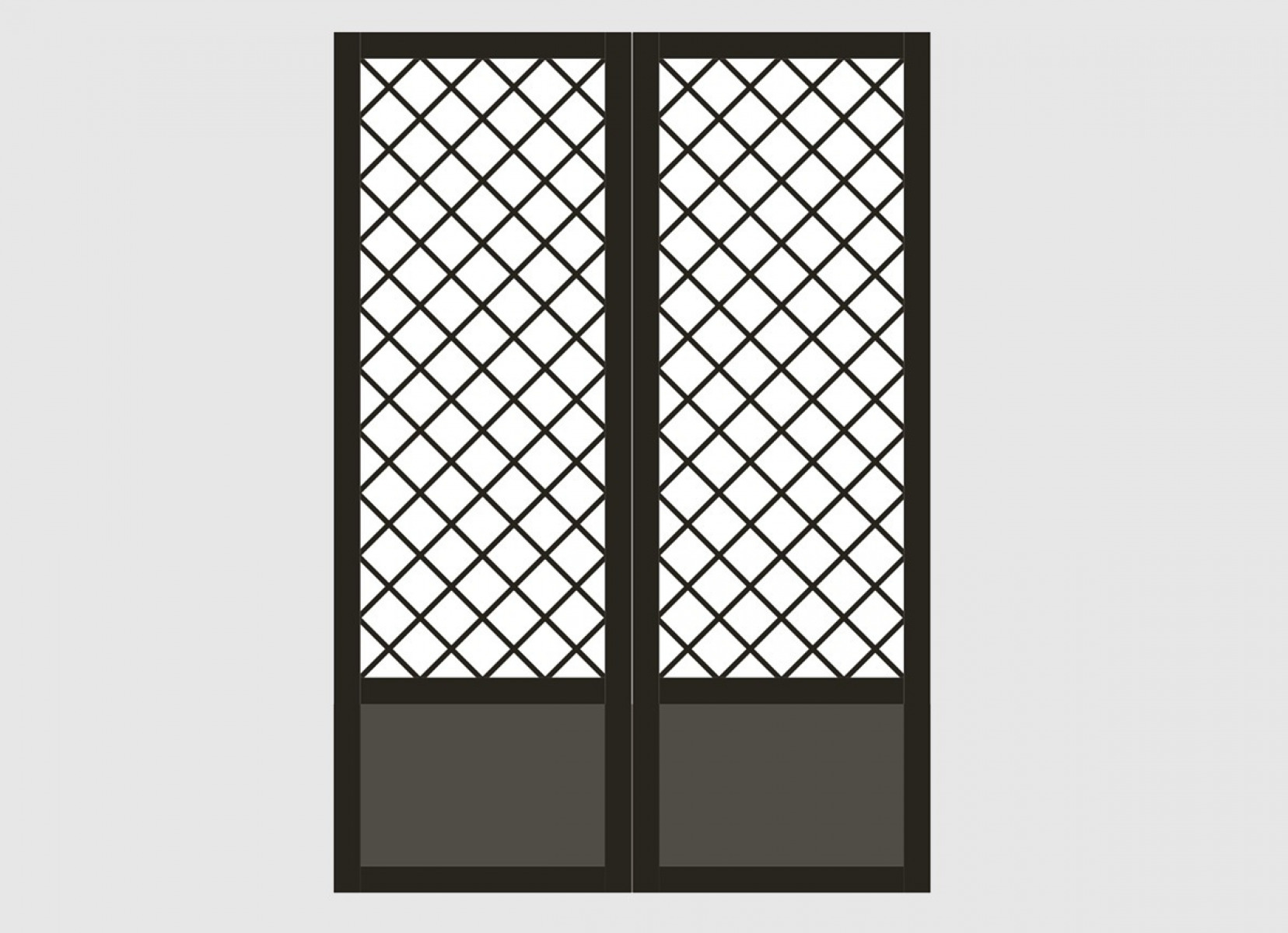
Bit-sal is a changho joined with slats set at 45° and 135°. Since the slats from the two directions meet each other at right angles, each cell is a square — just one turned 45° as a whole. Unlike se-sal and jeongja-sal, joined from slats standing straight, every line in this changho runs on a diagonal.
The Name
"Bit" is a native Korean word meaning "slanted." Bitgeum (diagonal line), bitbyeon (hypotenuse), bitdaeda (to hold at an angle, to compare obliquely) — all belong to the same family. It's called bit-sal simply because the slats are laid on a slant.
Se-sal took its name from "fine" (細) slats, jeongja-sal from the shape of the character 井 — names built by borrowing Hanja. Bit-sal is different. It's a name that calls the shape the slats make exactly what it is, in plain Korean.
That doesn't mean it has no Hanja spelling at all. The Changdeokgung Suri Dogam Uigwe and the Hwaseong Seongyeok Uigwe record it as sachang (斜窓) — "sa" meaning slanted. "Sal" was sometimes transliterated as jeon (箭, "arrow"), too. Se-sal became sejeonchang (細箭窓), bit-sal became sajeonchang (斜箭窓), and a changho layering jeongja-sal joinery on top became gyeokjasajeonchang (格子斜箭窓). The pattern of rendering "sal" as 箭 is consistent throughout.
But this isn't the root of the name — it's a transliteration made for the record. A spoken Korean name existed first, and it was converted into Hanja by meaning when it needed to go into a document. Which is why a half-Hanja spelling like "bit箭" was never really a thing. In Korean, it's bit-sal; in Hanja, it's sachang.
The Joinery
Where slats meet, it's a half-lap joint. Remove half the material from each and fit them together so the outer faces line up as a single plane. Since the slats sit at 45° and 135° and meet each other at right angles, the notch's width matches the slat's width exactly. Up to here, there's no difference from jeongja-sal. The grid has simply turned 45° as a whole.
What changes is where it meets the frame. A slat standing straight just needs a tenon cut and slotted into a hole, but with bit-sal, no single slat reaches the frame on its own. A slat coming down from above and a slat coming up from below meet right in front of the frame.
The ends of these two slats are cut off at 45°. Bring the two together, and they form a single triangular tenon. The frame is grooved just wide enough to receive that triangle's base.
The groove's width isn't the same as the slat's width. It comes out to the slat width multiplied by √2 — roughly 1.4 times. The frame stands square, horizontal and vertical, while the slats come in at 45°, so it's only here that the angle between them shifts things. The moment you set the slat width, the groove width is set along with it.
The Proportion of a Cell
In se-sal and jeongja-sal, the cell's vertical is set a little longer. A perfect square ends up looking like it spreads sideways. It's not something a ruler settles — it's something the eye settles.
Bit-sal has no room for that.
Stretching or shrinking a cell would require changing the angle the slats travel at, and if that angle shifts even slightly, the slats no longer meet at right angles. Which means the joinery simply doesn't come together. The perfect square that se-sal and jeongja-sal sidestep is something bit-sal can never escape.
So what can actually be decided in bit-sal is the number of cells and the width of the slats.
The cell count isn't a number that comes out of a calculation. It's caught by eye. Since there's no room to adjust the cell's proportion, all the work the eye would normally do elsewhere gets pulled forward and concentrated into this one spot.
→ Cell proportion is covered in detail in "The Eye Gets Fooled" (What the Eye Does, What the Mind Does, No. 1). (link)
Where It Was Used
It was widely used as a room's entrance door. The bulbalgi of a bunhapmun was often joined in bit-sal as well. It's even more common in temple halls.
The first time I saw bit-sal at the Myeongbujeon Hall of Muryangsa Temple in Buyeo, I stood in front of it for a long while. It was an old changho, but what struck me wasn't a sense of antiquity — if anything, it looked like something drawn just now. That was probably because only the diagonals remained on the surface. The dancheong paintwork, its colors weathered by the years, sat layered on top.
Source
- Changdeokgung Suri Dogam Uigwe (Royal Protocol of the Changdeokgung Repair Directorate), Hwaseong Seongyeok Uigwe (Royal Protocol of the Hwaseong Fortress Construction)
- Ju Nam-cheol, Korea's Doors and Changho
- National Institute of Korean Language, Standard Korean Dictionary
Browse the pattern designs in Pyeongmok Studio
Go to the Collection