Wanja-sal | A Pattern Overflowing with Meaning
This series · The Changho Glossary · No. 5 (14 episodes total) Ongoing
"Sorting out the names and joinery of traditional changho, one at a time."
- No. 1 Jeongja-sal | A Changho Joined into the Character 井
- No. 2 Se-sal (細살) | A Changho Set with Fine Slats, Packed Close
- No. 3 Bit-sal | A Changho Joined with Slats Set on the Diagonal
- No. 4 Aja-sal | A Pattern With No Good Meaning
- No. 5 Wanja-sal | A Pattern Overflowing with Meaning
- No. 6 Sutdae-sal | A Changho Joined with Broken Slats
- No. 7 Semo-sotgeul-sal | A Changho Where the Cells Come Out as Triangles
- No. 8 Yukmo-sotgeul-sal | A Changho Where the Cells Come Out as Hexagons
- No. 9 Gyeokja-bit-sal | A Changho Layering Diagonal Lattice Over a Grid
- No. 10 Gwigap-sal | Tenon or Notch?
- No. 11 Yongja-sal | A Jeongja-sal Scaled Up
- No. 12 Changho Hung in Layers | Ssangchang, Yeongchang, Heukchang, Gapchang
- No. 13 Changho Built into the Wall | Bongchang, Salchang, Gwangchang, Deulchang
- No. 14 Small Changho | Baraji, Nukkup, Changgyeong
Originally written in Korean by the author. Translated with the help of AI. Read the original
You are free to quote and excerpt posts and records from the Pyeongmok blog, as long as you credit the source (pyeongmok.com).
Wanja-sal | Even With Too Much Meaning, There's Still Only One Pattern
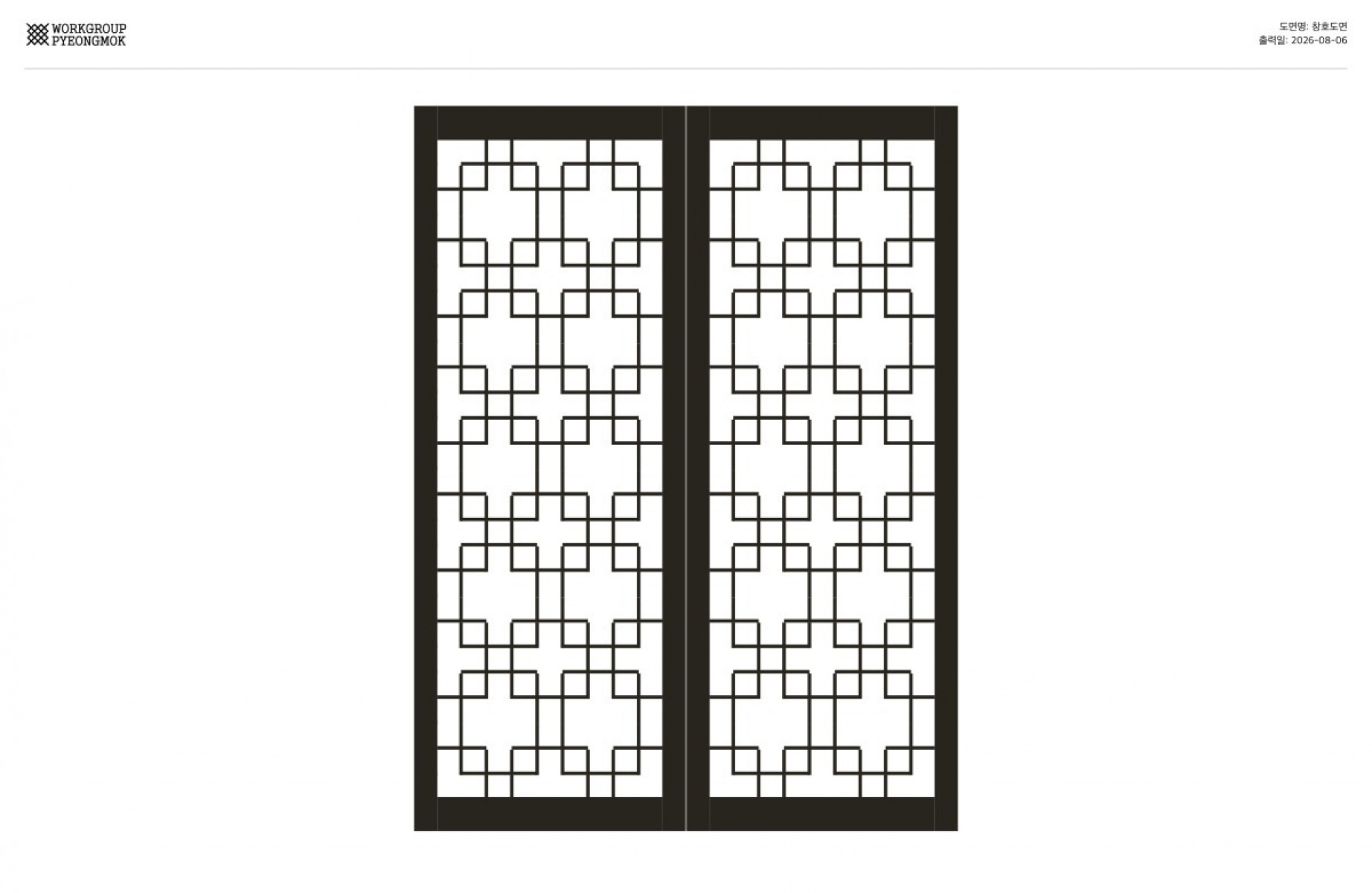
Wanja-sal is a changho joined into the shape of the character 卍.
卍 is a mark of the Buddha. The Avatamsaka Sutra states that this shape appears on the Tathagata's chest. Yi Deok-mu recorded the same account in his Cheongjanggwan Jeonseo. Citing the Fayuan Zhulin, he writes that the Buddha was born with the manja on his chest; citing the Nengyan Jing Yaojie, he writes that it marks an auspicious omen and gathers together every virtue.
Gilsang mandeok (吉祥萬德, "boundless auspicious virtue") — that is the meaning of wanja-sal.
That's the answer, as far as it goes.
Wanja-sal was used often in the anbang, the main inner room, of an ordinary home. It also appears in the daecheong hall of the inner quarters, or in the sarangbang. It's a pattern that belongs to an inner door, more than an outer changho exposed to the rain.
It's rare for it to be hung as a single panel. It was mainly used in spots where several panels stand side by side, like the bunhapmun in front of a daecheong hall.
But that isn't the only meaning it carries.
Under the same entry, Yi Deok-mu also set down a different interpretation, side by side with the first. It comes from the Ming-dynasty scholar Wei Jiao's Liushu Zhengyun. 卍, it says, marks the end of numbers, and the ancient people who took up two strokes of 一 were drawing on the principle that all things arise from 一 and return to 一 to end, and that this cycle is endless. This isn't a Buddhist story at all. It's a story about numbers and cycles.
Even the translations diverge. Kumarajiva and Xuanzang rendered this character as deok (德, "virtue"); Bodhiruci rendered it as man (萬, "ten thousand"). Under Empress Wu Zetian, it was fixed to be read as man (萬).
Theories of its origin diverge even further. Some say it's the sun; some say flowing water; some say hair coiled into a circle; some say a numinous light. It isn't even unique to India. The same shape appears in many places around the world. It's the Buddha's chest, and the spot where every virtue gathers, and the end of numbers, and the principle of cycles, and the sun, and water, and light. Which one is correct still hasn't been settled.
And yet there's only one pattern.
The meanings are this numerous, but wanja-sal is one single thing. Join it along the strokes of 卍 and it's wanja-sal; anything else, and it isn't. It doesn't differ from carpenter to carpenter.
That's because what's holding it in place isn't the meaning. It's the strokes. The strokes of 卍 are fixed. One horizontal, one vertical overlapping, with all four ends bent in the same direction. That's all there is to it. This shape stays exactly the same no matter how many meanings pile onto it.
You understand this once you actually join it.
Wanja-sal's rule is unambiguous. So the person joining it never wavers. There's no hesitating over where "wanja" stops, and since the strokes are fixed, where each slat goes is fixed too. The hand doesn't have to think — it just comes out clean and precise, exactly as it should.
The same goes for the viewer. Even with several panels lined up side by side, the eye stays at ease. Adding more panels doesn't scatter the pattern.
The only thing that can be carried over into lattice is a stroke. Meaning never becomes a slat.
Set it side by side with aja-sal, and it becomes clear.
In the previous piece, I wrote that aja-sal scattered. Where "aja" stops differs from carpenter to carpenter. That's because the form holding it down was loose.
It isn't that one scattered for lack of meaning, and the other survived intact because it had plenty of meaning. In neither case did meaning have any say in the decision. What decided it was the form.
We often use the phrase "gilsangmun" — an auspicious pattern.
Meaning a pattern that invites good fortune. That's not wrong. But the order is backwards.
A pattern doesn't survive because it carries meaning. It survived because its form was unambiguous, and because it survived, meaning kept attaching itself to it. The Buddha's chest, the end of numbers, the sun — all of it attached itself that way.
While seven meanings attached themselves one after another, the pattern itself never once wavered.
Whatever it is, if its boundary is unambiguous, everything that comes after it stays steady.
Meaning comes later.
Source
- Avatamsaka Sutra, Volume 48
- Yi Deok-mu, Cheongjanggwan Jeonseo, "Angyeopgi," entry "man (卍)"
- "Manja," "Manjamun," Encyclopedia of Korean Culture
Try designing this lattice yourself
Try adjusting the Wanja-sal (Swastika-motif Lattice) pattern covered in this post yourself, right in the studio.
Open in studioThis lattice belongs to the Wanja-sal (Swastika-motif Lattice) series — see real production examples in the Collection.
View Wanja-sal (Swastika-motif Lattice) in the Collection