Jeongja-sal | A Changho Joined into the Character 井
This series · The Changho Glossary · No. 1 (14 episodes total) Ongoing
"Sorting out the names and joinery of traditional changho, one at a time."
- No. 1 Jeongja-sal | A Changho Joined into the Character 井
- No. 2 Se-sal (細살) | A Changho Set with Fine Slats, Packed Close
- No. 3 Bit-sal | A Changho Joined with Slats Set on the Diagonal
- No. 4 Aja-sal | A Pattern With No Good Meaning
- No. 5 Wanja-sal | A Pattern Overflowing with Meaning
- No. 6 Sutdae-sal | A Changho Joined with Broken Slats
- No. 7 Semo-sotgeul-sal | A Changho Where the Cells Come Out as Triangles
- No. 8 Yukmo-sotgeul-sal | A Changho Where the Cells Come Out as Hexagons
- No. 9 Gyeokja-bit-sal | A Changho Layering Diagonal Lattice Over a Grid
- No. 10 Gwigap-sal | Tenon or Notch?
- No. 11 Yongja-sal | A Jeongja-sal Scaled Up
- No. 12 Changho Hung in Layers | Ssangchang, Yeongchang, Heukchang, Gapchang
- No. 13 Changho Built into the Wall | Bongchang, Salchang, Gwangchang, Deulchang
- No. 14 Small Changho | Baraji, Nukkup, Changgyeong
Originally written in Korean by the author. Translated with the help of AI. Read the original
You are free to quote and excerpt posts and records from the Pyeongmok blog, as long as you credit the source (pyeongmok.com).
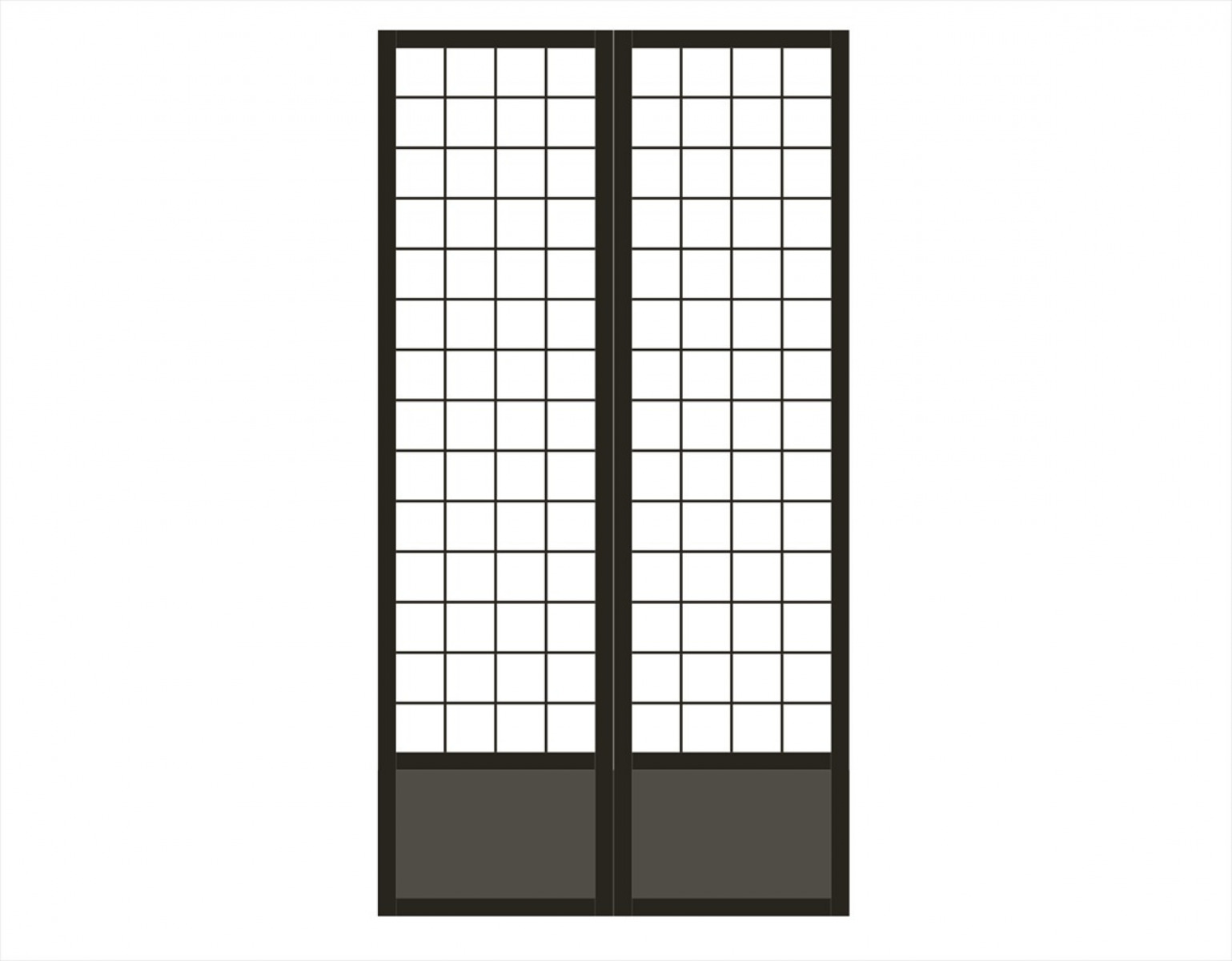
Jeongja-sal — A Changho Joined into the Character 井
Jeongja-sal is a changho whose slats run straight, horizontal and vertical, forming a grid that resembles the character 井 (jeong).
It's the simplest of all lattice joineries, and for that reason, the most widely used.
The Name
It's called jeongja-sal because it resembles the character 井 (jeong). In Korean it's also called umul-sal ("well lattice"). Join the same grid onto a ceiling, and you get umul-banja, umul-cheonjang ("well ceiling").
It's a rare case where the Hanja name and the native Korean name both survived side by side.
The character 井 itself is, in a sense, a carpenter's character. It wasn't drawn to depict well water — it depicts the frame of logs stacked crosswise over a well's opening.
It's not that slats were joined to form the character 井; rather, a wooden frame that was already being built this way became a character, and that character then came back around to become the name of a lattice.
Naming a lattice pattern after the shape of a character isn't unique to jeongja-sal. Wanja-sal is named after 卍, aja-sal after 亞, and yongja-sal after 用.
These aren't names given for their meaning — they're names that simply describe a shape. The character 井 has long carried associations with wells, the well-field land system (jeongjeonje), and the constellation Jeongsu (井宿), and plenty of writing interprets jeongja-sal through those meanings.
But there's no confirmed record that a Joseon carpenter, while joining a changho, was thinking about that meaning.
It's closer to the truth to say the joinery came first, and the meaning was attached afterward.
The Joinery
Where a horizontal slat meets a vertical one, a half-lap notch is cut into each. Remove half the material from each and fit them together, and the two slats' outer faces line up flush as a single plane.
No nails, no glue. That's the entire technique. Because of this, very little wood is wasted in cutting, and if a single cell is ever damaged, only that spot needs to be replaced. Jeongja-sal was used everywhere — from ordinary homes to palaces to temples — not because of some auspicious meaning, but because of this.
The Proportion of a Cell
A cell isn't a perfect square. The vertical is set a little longer.
That's because a perfect square actually ends up looking like it's spreading sideways. The proportion changes again as the door gets bigger, and it also differs from hand to hand.
It's not something a ruler settles — it's something the eye settles.
→ Covered in detail in "The Eye Gets Fooled" (What the Eye Does, What the Mind Does, No. 1). (link)
Where It Was Used
It was used widely as the outer layer of double changho in homes, palaces, and temples alike. A common configuration hangs se-sal or another lattice on the inside, with jeongja-sal mounted outside it.
In palaces, it was also used often on the front changho of main halls, because the sheer number of lattice cells makes it sturdy.
It isn't a lattice tied to any single kind of building — it's a lattice that rose all the way from the humblest homes to the grandest halls, built with the exact same joinery.
Source
- National Institute of Korean Language, Standard Korean Dictionary, entry "jeongja-sal"
- Encyclopedia of Korean Culture, entry "changho (changho)" (Academy of Korean Studies)
You can draw it right on screen, adjusting the cell count and slat width as you go.
Go to the Collection