Yongja-sal | A Jeongja-sal Scaled Up
This series · The Changho Glossary · No. 11 (14 episodes total) Ongoing
"Sorting out the names and joinery of traditional changho, one at a time."
- No. 1 Jeongja-sal | A Changho Joined into the Character 井
- No. 2 Se-sal (細살) | A Changho Set with Fine Slats, Packed Close
- No. 3 Bit-sal | A Changho Joined with Slats Set on the Diagonal
- No. 4 Aja-sal | A Pattern With No Good Meaning
- No. 5 Wanja-sal | A Pattern Overflowing with Meaning
- No. 6 Sutdae-sal | A Changho Joined with Broken Slats
- No. 7 Semo-sotgeul-sal | A Changho Where the Cells Come Out as Triangles
- No. 8 Yukmo-sotgeul-sal | A Changho Where the Cells Come Out as Hexagons
- No. 9 Gyeokja-bit-sal | A Changho Layering Diagonal Lattice Over a Grid
- No. 10 Gwigap-sal | Tenon or Notch?
- No. 11 Yongja-sal | A Jeongja-sal Scaled Up
- No. 12 Changho Hung in Layers | Ssangchang, Yeongchang, Heukchang, Gapchang
- No. 13 Changho Built into the Wall | Bongchang, Salchang, Gwangchang, Deulchang
- No. 14 Small Changho | Baraji, Nukkup, Changgyeong
Originally written in Korean by the author. Translated with the help of AI. Read the original
You are free to quote and excerpt posts and records from the Pyeongmok blog, as long as you credit the source (pyeongmok.com).
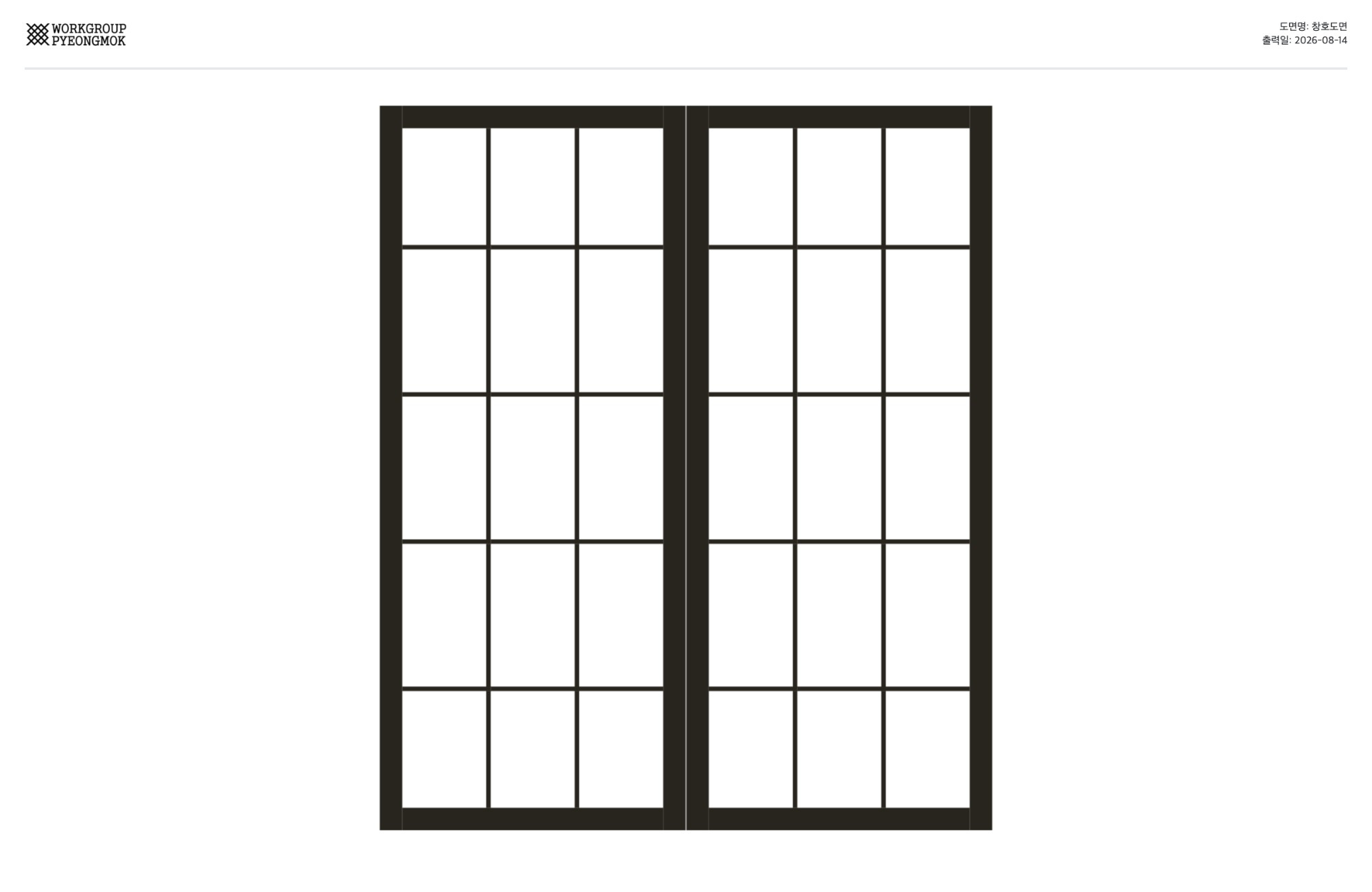
Yongja-sal is jeongja-sal scaled up. Fewer slats means larger cells. The cells come out as large squares. It's an extremely economical lattice.
It's called yongja-sal because its shape resembles the character 用 (yong). Unlike 完 or 亞, this isn't a character borrowed for its meaning — only its shape was borrowed for the name.
The joinery is a half-lap, the same as jeongja-sal. That makes sense, since it's the same joinery simply spread out wider.
It's used in the sarangbang, the men's quarters — an interior changho. Ju Nam-cheol describes a sadaebu house's changho standing layered from outside to inside: an outer deotchang first, then a sachang behind it, then a sliding double changho (ssangchang) behind that. Yongja-sal belongs at that ssangchang layer — the same tier as aja-sal and wanja-sal.
One more name is worth noting here. The Standard Korean Dictionary defines beomsal-jangji as a jangjimun (sliding partition door) whose lattice is loosely joined into the shape of the character 井. Since that's jeongja-sal spread loose, it overlaps with yongja-sal. That said, beomsal also has variants such as ssangjul-beomsal-chang, which pairs two slats side by side, so whether the two terms are the same thing, or "beomsal" is simply the broader term, hasn't been settled yet.
Source
- Ju Nam-cheol, "The Face of a House: Changho," Munhwajae Sarang, Cultural Heritage Administration, 2015
- Ju Nam-cheol, Korea's Doors and Changho, Daewonsa, 2001
- National Institute of Korean Language, Standard Korean Dictionary, entry "beomsal-jangji"
Try designing this lattice yourself
Try adjusting the Beomsal-jangji (Wide-bar Lattice Door) pattern covered in this post yourself, right in the studio.
Open in studioThis lattice belongs to the Beomsal-jangji (Wide-bar Lattice Door) series — see real production examples in the Collection.
View Beomsal-jangji (Wide-bar Lattice Door) in the Collection