
Small Changho | Baraji, Nukkup, Changgyeong
This series · The Changho Glossary · No. 14 (14 episodes total) Ongoing
"Sorting out the names and joinery of traditional changho, one at a time."
- No. 1 Jeongja-sal | A Changho Joined into the Character 井
- No. 2 Se-sal (細살) | A Changho Set with Fine Slats, Packed Close
- No. 3 Bit-sal | A Changho Joined with Slats Set on the Diagonal
- No. 4 Aja-sal | A Pattern With No Good Meaning
- No. 5 Wanja-sal | A Pattern Overflowing with Meaning
- No. 6 Sutdae-sal | A Changho Joined with Broken Slats
- No. 7 Semo-sotgeul-sal | A Changho Where the Cells Come Out as Triangles
- No. 8 Yukmo-sotgeul-sal | A Changho Where the Cells Come Out as Hexagons
- No. 9 Gyeokja-bit-sal | A Changho Layering Diagonal Lattice Over a Grid
- No. 10 Gwigap-sal | Tenon or Notch?
- No. 11 Yongja-sal | A Jeongja-sal Scaled Up
- No. 12 Changho Hung in Layers | Ssangchang, Yeongchang, Heukchang, Gapchang
- No. 13 Changho Built into the Wall | Bongchang, Salchang, Gwangchang, Deulchang
- No. 14 Small Changho | Baraji, Nukkup, Changgyeong
Originally written in Korean by the author. Translated with the help of AI. Read the original
You are free to quote and excerpt posts and records from the Pyeongmok blog, as long as you credit the source (pyeongmok.com).
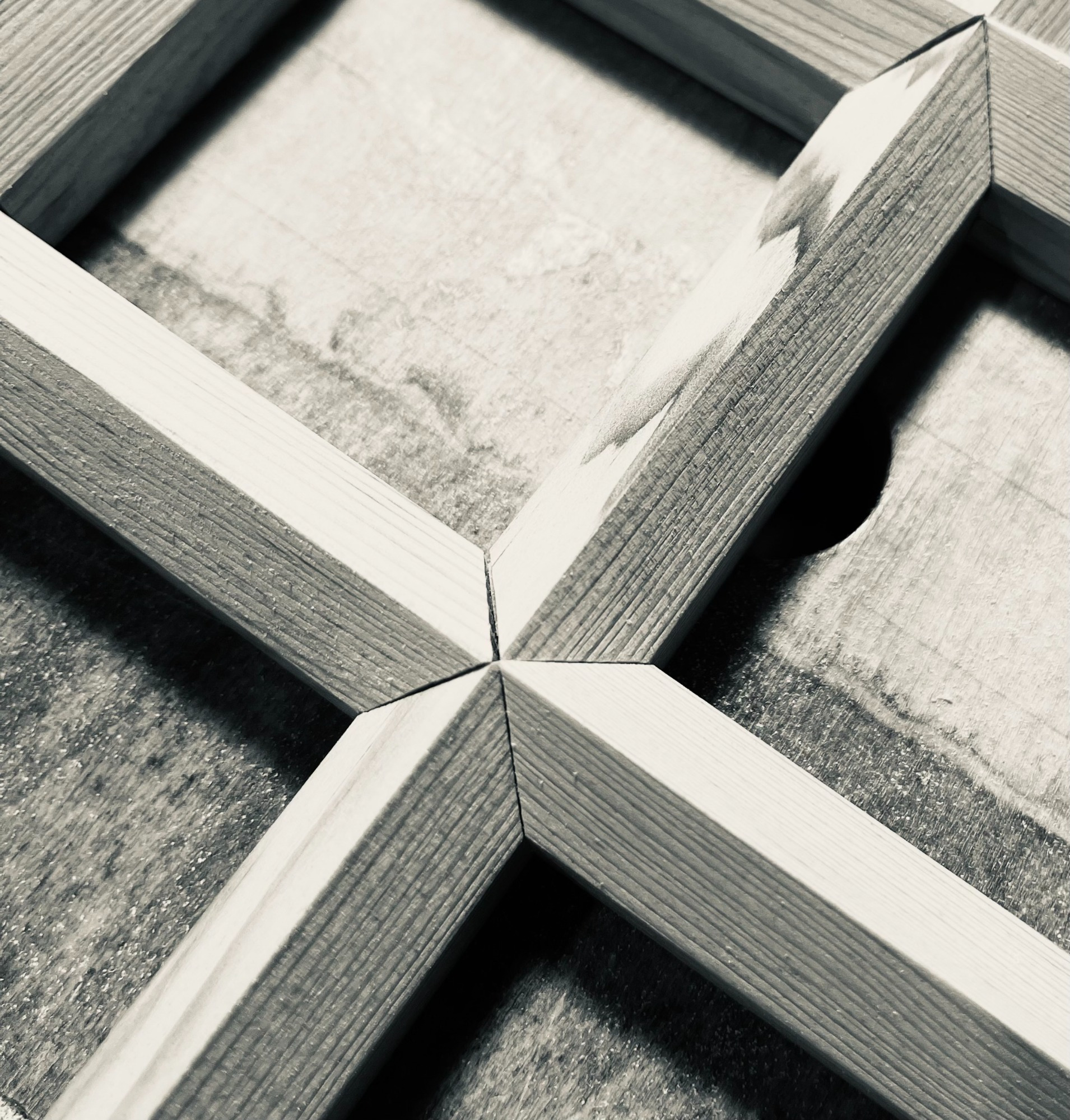
Small Changho | Baraji, Nukkup, Changgyeong
A changho inside a changho.
Sometimes a palm-sized opening is set high on a wall; sometimes a single lattice cell is built to open on its own.
These small changho have plenty of names. But the names don't split cleanly from one another.
Baraji · Ssang-baraji
A very small changho set high on a wall.
A two-panel version is a ssang-baraji.
Nunsseop-baraji
A small changho built to open on its own, within one section of a larger changho.
Yakgye-baraji
A small changho cut into the service counter of a traditional herbal pharmacy, used for passing packets of medicine back and forth.
A rare case where the use itself became the name.
Nukkup
A small peephole changho, built with a narrow-slat frame that opens and closes, set within one section of a larger changho.
In Jang Gi-in's plates, it's drawn right alongside a changgyeong. It appears that a changgyeong and a nukkup were sometimes set into the same changho together.
Ttoe-chang
A changho styled very small. Also written ttoe-changmun or doe-changmun.
Nunkkopjaegi-chang
A very small changho set beside a single hinged door.
In a house with no one to answer the main gate, this changho was opened to check who was outside.
Kkoe-chang
A changho found on a bunhapmun.
Jang Gi-in's body text describes it as a changho on the bunhapmun. His classification table describes it as a changho above the bunhapmun. Whether it's on it or above it is left unresolved.
Changgyeong (窓鏡) · Changgyeong-teul (窓鏡框)
Glass set into part of a paper changho so you can see outside. The frame holding the glass is the changgyeong-teul.
The order of construction survives in the record: the glass is fitted and trimmed first, then the changho paper is applied, and finally the center is cut away.
It was usually set into a large section of a wanja-chang or aja-chang.
Why the Names Overlap
Nunsseop-baraji · Nukkup · Kkoe-chang.
All three are "a small changho within one section of a larger changho." Go by definition alone, and they don't separate at all.
Baraji · Ttoe-chang · Nunkkopjaegi-chang are the same way. All three are simply "a very small changho."
Lattice names don't work like this.
Se-sal and jeongja-sal are joined by different methods. Semo-sotgeul-sal and yukmo-sotgeul-sal split depending on where the vertical slat sits. A different joinery means a different name.
Small changho are different. The joinery is the same. Only the location and the use differ.
A yakgye-baraji is a yakgye-baraji because it sits in an herbal pharmacy. A nunkkopjaegi-chang gets its name from peering outside beside a door. A nukkup gets its name from having its own separate frame built in.
So when the location disappears, the name fades too. Once herbal pharmacies vanish, "yakgye-baraji" survives only as a name.
Nunsseop-baraji, yakgye-baraji, and nukkup — all three survive as names only in Jang Gi-in's Changho.
I haven't found them in other sources. But since plates of them are included, the physical objects clearly did exist.
There seems to be an order to how a name fades. A name born from the joinery survives; a name born from a location goes wherever that location goes.
Names Left Out of This Glossary
Jungchang (中窓) · Yeonchang (連窓) · Jung-yeonchang (中連窓)
These appear in Jang Gi-in's classification table, but they aren't terms from traditional changho.
A yeonchang is what you call it when two or more changho, each with its own sash and frame, have their adjacent frames joined together — used for a large opening. It's a term from modern changho. A jung-yeonchang is the same thing with a center post set between them.
Jungchang hasn't been confirmed anywhere.
The neonchul family hasn't been confirmed yet either.
Source
- Jang Gi-in, Changho (Korean Architecture Compendium I), Boseonggak, first edition 1983, reprint 2019
- National Institute of Korean Language, Standard Korean Dictionary
Browse the pattern designs in Pyeongmok Studio
Go to the Collection