Yukmo-sotgeul-sal | A Changho Where the Cells Come Out as Hexagons
This series · The Changho Glossary · No. 8 (14 episodes total) Ongoing
"Sorting out the names and joinery of traditional changho, one at a time."
- No. 1 Jeongja-sal | A Changho Joined into the Character 井
- No. 2 Se-sal (細살) | A Changho Set with Fine Slats, Packed Close
- No. 3 Bit-sal | A Changho Joined with Slats Set on the Diagonal
- No. 4 Aja-sal | A Pattern With No Good Meaning
- No. 5 Wanja-sal | A Pattern Overflowing with Meaning
- No. 6 Sutdae-sal | A Changho Joined with Broken Slats
- No. 7 Semo-sotgeul-sal | A Changho Where the Cells Come Out as Triangles
- No. 8 Yukmo-sotgeul-sal | A Changho Where the Cells Come Out as Hexagons
- No. 9 Gyeokja-bit-sal | A Changho Layering Diagonal Lattice Over a Grid
- No. 10 Gwigap-sal | Tenon or Notch?
- No. 11 Yongja-sal | A Jeongja-sal Scaled Up
- No. 12 Changho Hung in Layers | Ssangchang, Yeongchang, Heukchang, Gapchang
- No. 13 Changho Built into the Wall | Bongchang, Salchang, Gwangchang, Deulchang
- No. 14 Small Changho | Baraji, Nukkup, Changgyeong
Originally written in Korean by the author. Translated with the help of AI. Read the original
You are free to quote and excerpt posts and records from the Pyeongmok blog, as long as you credit the source (pyeongmok.com).
Definition
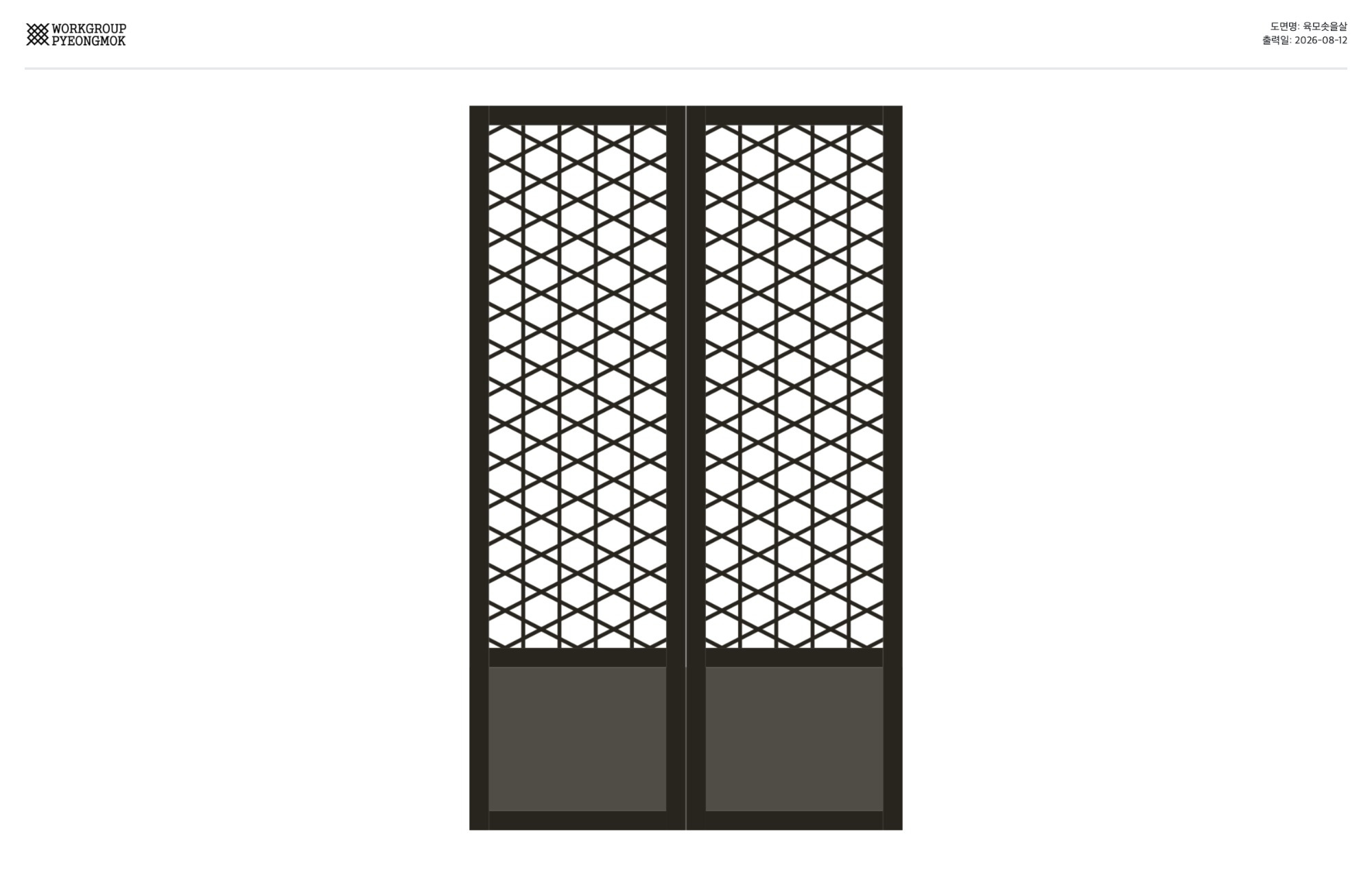
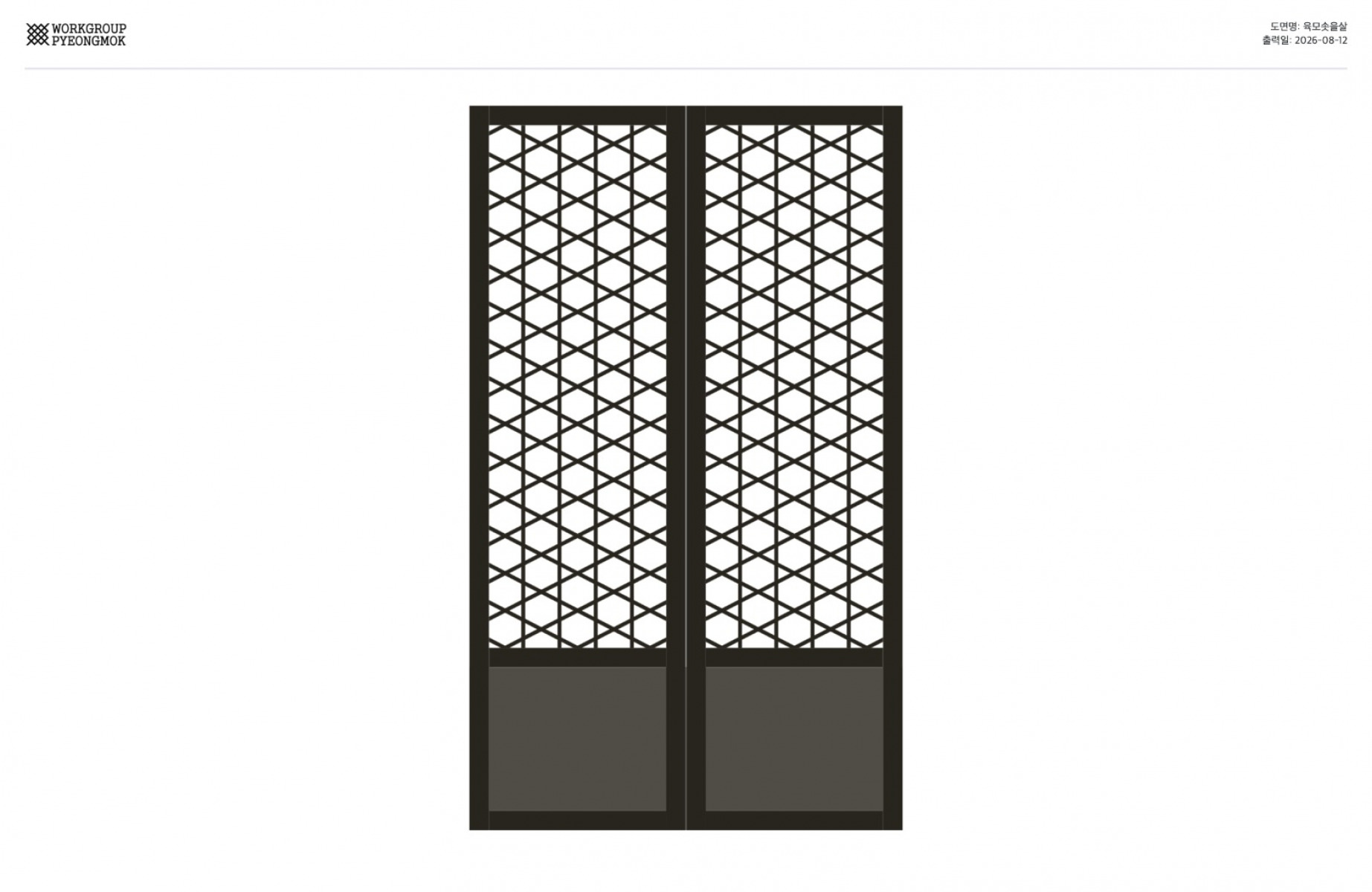
Yukmo-sotgeul-sal is a changho where slats are laid diagonally at 30° and crossed, with a vertical slat set between crossing points so that the cells come out as regular hexagons.
The slats are identical to the semo-sotgeul-sal from the previous piece. Same angle, same count. The only difference is where the vertical slat goes.
One Position for the Vertical Slat
Cross the slats at 30° and each section becomes a diamond. Up to here, it's identical to semo-sotgeul-sal.
Set the vertical slat on the crossing point, and the diamond splits in half into a triangle. That's semo-sotgeul-sal.
Set the vertical slat between two crossing points, and it becomes a hexagon. That's yukmo-sotgeul-sal.
It's a difference of a hand's width. And yet the pattern changes completely.
And the Joinery Changes Too
This is the heart of this changho.
In semo-sotgeul-sal, three slats meet at a single point. So it's joined with a triple-notch joint. The slat's width has to be divided into thirds, which weakens it, and it snaps easily during assembly.
Yukmo-sotgeul-sal has no spot where three slats meet. Because the vertical slat steers clear of the crossing point. Only two ever meet at once.
So every joint is a half-lap. Look at any spot, and it's a half-lap joint.
Of course, there's still an angle involved. It's not a half-lap at a right angle — it's a half-lap that interlocks on a slant. So the notch's shoulder comes out on a diagonal.
Even so, nothing is divided into thirds. Half the slat's material always remains.
Just by moving the vertical slat's position by a hand's width, the pattern changes, the joinery changes, and even the difficulty of joining it changes.
That doesn't mean it's easy, though.
The half-laps have to be cut alternating front and back. Doing that, the angles are easy to mix up. It's an easy mistake to make.
Semo-sotgeul-sal breaks under force; yukmo-sotgeul-sal goes wrong the instant your attention slips.
Where It Was Used
Same as semo-sotgeul-sal. Used mainly in palace halls and temples, and as an exterior changho.
The same goes for flowers. Flowers were sometimes carved onto the slats, and dumili (a double-groove moulding planed along the slat face) were used to add flourish.
How the Name Is Written
There's a spot in the literature where it's written yukgak-soseul-sal — page 46 of Jang Gi-in's Changho.
"Soseul" is simply how "sotgeul" sounds when pronounced. Attach "-eul" to "sot-," and the ㅅ shifts onto the next syllable, producing the sound [soseul]. That's liaison. It's a completely natural sound shift, and everyone pronounces it that way when speaking.
But writing it down is a different matter. Korean spells by sound, except that a morpheme carrying meaning is spelled out in its true underlying form. That's exactly why sotgeul-daemun isn't written soseul-daemun. Transcribe the sound directly, and the word's root gets obscured. It's called sotgeul-sal because the slats rise (sotda) in relief — write it as soseul-sal, and that meaning disappears.
The same page 46 of the same book uses sotgeul-sal in its body text. Only the figure's caption says soseul-sal. This sort of inconsistency is common in older books, and all that's left for us now is to decide which spelling to use going forward.
This changho, too, goes by several names.
Jang Gi-in's Changho calls it yukmo-sotgeul-sal on page 40 and yukgak-soseul-sal on page 46. It's also called eogeum-yukmo.
Within six pages, both halves of the name change at once.
I've covered this problem separately. → Jang Gi-in's Changho | Where It Comes Apart
The standard here is the same one. Just look at the cell.
If the cell is a regular hexagon, it's yukmo-sotgeul-sal. If it's a triangle, it's semo-sotgeul-sal.
Source: Jang Gi-in, Changho (Korean Architecture Compendium I), Boseonggak, 1983 (2019 reprint), pp. 40–46
Browse the pattern designs in Pyeongmok Studio
Go to the Collection