Aja-sal | A Pattern With No Good Meaning
This series · The Changho Glossary · No. 4 (14 episodes total) Ongoing
"Sorting out the names and joinery of traditional changho, one at a time."
- No. 1 Jeongja-sal | A Changho Joined into the Character 井
- No. 2 Se-sal (細살) | A Changho Set with Fine Slats, Packed Close
- No. 3 Bit-sal | A Changho Joined with Slats Set on the Diagonal
- No. 4 Aja-sal | A Pattern With No Good Meaning
- No. 5 Wanja-sal | A Pattern Overflowing with Meaning
- No. 6 Sutdae-sal | A Changho Joined with Broken Slats
- No. 7 Semo-sotgeul-sal | A Changho Where the Cells Come Out as Triangles
- No. 8 Yukmo-sotgeul-sal | A Changho Where the Cells Come Out as Hexagons
- No. 9 Gyeokja-bit-sal | A Changho Layering Diagonal Lattice Over a Grid
- No. 10 Gwigap-sal | Tenon or Notch?
- No. 11 Yongja-sal | A Jeongja-sal Scaled Up
- No. 12 Changho Hung in Layers | Ssangchang, Yeongchang, Heukchang, Gapchang
- No. 13 Changho Built into the Wall | Bongchang, Salchang, Gwangchang, Deulchang
- No. 14 Small Changho | Baraji, Nukkup, Changgyeong
Originally written in Korean by the author. Translated with the help of AI. Read the original
You are free to quote and excerpt posts and records from the Pyeongmok blog, as long as you credit the source (pyeongmok.com).
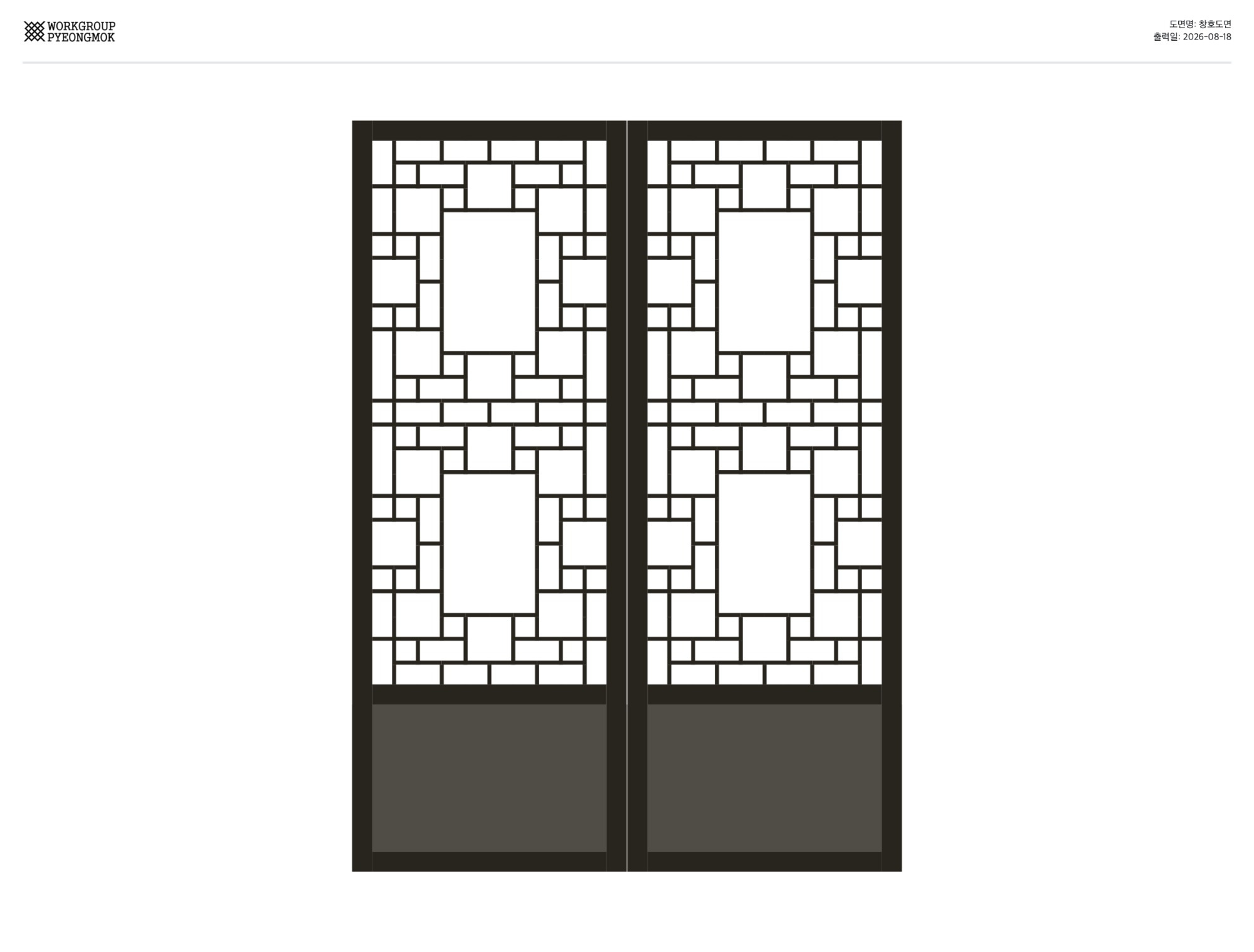
Every time I join aja-sal, it's a mess.
I can never tell where "aja" stops. There are genuinely so many variations of the pattern. Something that looks like it might or might not be aja keeps turning up.
Wanja-sal isn't like this. The character 卍 is fixed, so the pattern is fixed too. Nothing to be confused about.
I spent a long time wondering why aja alone is this way.
It seems to be because the character has no meaning.
Look it up in a dictionary, and all you get is the shape. A changho whose lattice is joined into the shape of the character 亞. Widely used as a sliding door between rooms. That's it.
Why 亞 of all characters — nothing anywhere says. Even books on changho just write the name down and move on.
So I opened a character dictionary.
The Shuowen Jiezi glosses 亞 as chu (醜), meaning "ugly." It's said to depict the shape of a person with a hunched back.
The Erya glosses it as cha (次) — "second," "inferior to." There's a usage recording Zhuge Liang being called the "亞" of Guan Zhong and Xiao He. The Zengyun glosses it as so (少), meaning "few, scant."
Even the Korean gloss we use for this character is beogeum (버금) — "second-best." Not the foremost, but the one after it.
And there's this, too: 亞 was originally a character meaning "to decorate," but that meaning was pushed aside by a borrowed sense, so 土 (earth) was added to make 堊 (whitewash), and 心 (heart) was added to make 惡 (evil), splitting them off as separate characters.
The Zihui takes the view that 惡 branched off from 亞. In the Book of Han, there's even a place where "亞谷侯" is written as "惡谷" instead.
To sum up:
The original meaning is "ugly." The derived senses are "second-best" and "scant." Its root even connects to 惡, "evil."
Open a character dictionary, and there isn't a single good meaning in there.
And yet a Joseon carpenter joined this very character into the sliding door of an anbang, the main inner room.
Did they not know the meaning? Or did they know, and simply not care?
My guess is that they never asked the question in the first place.
What you look at while joining lattice isn't a character. It's a cell. Where this pattern locks together with a half-lap, how many parts the cell divides into, whether the proportion comes out right for the door's height. That's all you're looking at.
The shape of 亞 comes out if you remove a few slats from a jeongja-sal grid. It's a pattern that's simply good to join.
The name comes afterward. Join it, look at it, notice it resembles 亞 — and there's your aja-sal. That's the whole story.
Where it was placed probably played a part too.
Aja-sal sits on the inside. A sliding door between two rooms, the inner layer of a bulbalgi between a daecheong hall and a room. In a sadaebu house, the changho layer outward-to-inward as deotchang, sachang, ssangchang, gapchang, and the outermost deotchang was usually tti-sal, with aja-sal coming in behind it.
The outer changho takes the wind and rain. Its slats have to be thick and tightly packed. The joinery is tied to performance.
The inner one has no such constraint. The slats can be thin, the cells can be wide.
So aja-sal, in effect, had nothing holding it down on two fronts at once. No meaning holding it down, and no outdoor condition holding it down either.
Which brings us back to the start.
With wanja, a character held the pattern down. The strokes of 卍 are fixed. Join it exactly along those strokes and it's wanja-sal; anything else, and it isn't. There's no room for the carpenter to decide.
With aja, there was nothing to hold it down. All you have is "it resembles 亞." No one ever set how closely it has to resemble it to count as 亞.
So it scattered. Every carpenter joined it differently, and all of it gets called aja-sal.
It's still that way today. Every time I join it, I have to decide all over again where "aja" stops.
People often say a pattern carries meaning within it. That's only half true.
Meaning doesn't create a pattern. Meaning only holds a pattern in place.
Without a meaning to hold it down, a pattern scatters.
Source
- Shuowen Jiezi, entry "亞" — recorded under "亞" in the Kangxi Dictionary
- Erya, "Explaining Words" chapter — recorded under the same entry
- Zihui, entry jeongwa (井蛙) — recorded under the same entry
- "Changho (Changho)," Encyclopedia of Korean Culture
- "The Face of a House: Changho," Korea Heritage Service, Monthly Magazine Loving Our National Heritage
- Lee Wan-geon, "A Study on the Changho of the Bak Do-su House and the Jeong Won-tae House in Jecheon," Journal of the Korean Institute of Interior Design, Vol. 23, No. 5, 2014
Try designing this lattice yourself
Try adjusting the 정자살(Square Lattice) pattern covered in this post yourself, right in the studio.
Open in studioBrowse the pattern designs in Pyeongmok Studio
Go to the Collection