
Gyeokja-bit-sal | A Changho Layering Diagonal Lattice Over a Grid
This series · The Changho Glossary · No. 9 (14 episodes total) Ongoing
"Sorting out the names and joinery of traditional changho, one at a time."
- No. 1 Jeongja-sal | A Changho Joined into the Character 井
- No. 2 Se-sal (細살) | A Changho Set with Fine Slats, Packed Close
- No. 3 Bit-sal | A Changho Joined with Slats Set on the Diagonal
- No. 4 Aja-sal | A Pattern With No Good Meaning
- No. 5 Wanja-sal | A Pattern Overflowing with Meaning
- No. 6 Sutdae-sal | A Changho Joined with Broken Slats
- No. 7 Semo-sotgeul-sal | A Changho Where the Cells Come Out as Triangles
- No. 8 Yukmo-sotgeul-sal | A Changho Where the Cells Come Out as Hexagons
- No. 9 Gyeokja-bit-sal | A Changho Layering Diagonal Lattice Over a Grid
- No. 10 Gwigap-sal | Tenon or Notch?
- No. 11 Yongja-sal | A Jeongja-sal Scaled Up
- No. 12 Changho Hung in Layers | Ssangchang, Yeongchang, Heukchang, Gapchang
- No. 13 Changho Built into the Wall | Bongchang, Salchang, Gwangchang, Deulchang
- No. 14 Small Changho | Baraji, Nukkup, Changgyeong
Originally written in Korean by the author. Translated with the help of AI. Read the original
You are free to quote and excerpt posts and records from the Pyeongmok blog, as long as you credit the source (pyeongmok.com).
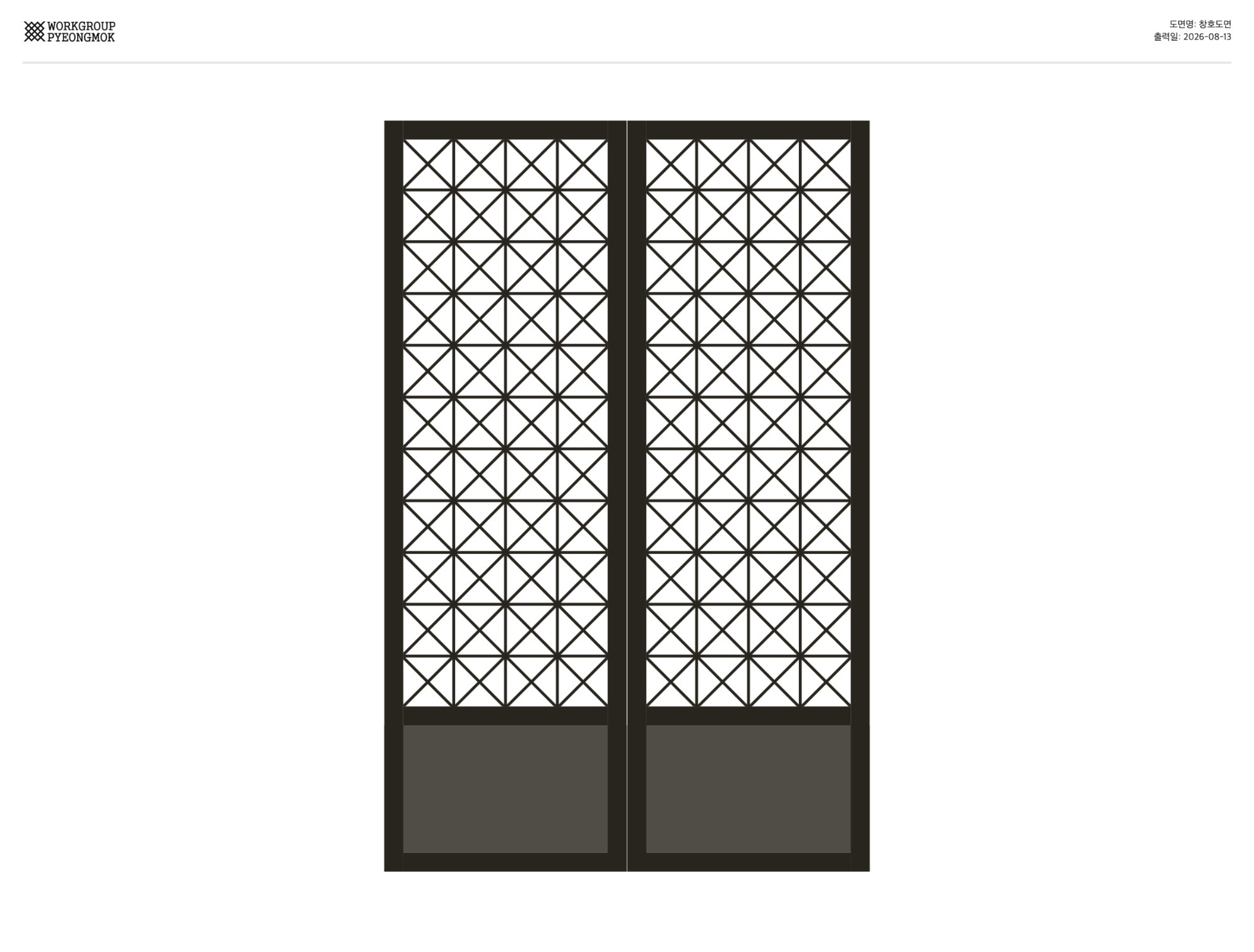
Gyeokja-bit-sal | A Changho Layering Diagonal Lattice Over a Grid
Gyeokja-bit-sal is a changho built by layering bit-sal over jeongja-sal. Two 45° diagonals cross the horizontal-vertical grid, so that each cell of the grid is further divided into four small triangles. It's a changho where two joineries overlap on a single face.
It was used on the exterior doors of palace halls and temples — the same setting as semo-sotgeul-sal, yukmo-sotgeul-sal, and bit-sal.
The joinery mixes two kinds. Where diagonal meets diagonal, it's a half-lap. Where horizontal, vertical, and both diagonals — four in all — converge on a single point, it's a quarter-notch: the slat's width is divided into four and each is cut away in turn.No flowers are carved into it. There's no room left for one. With the slats packed this densely, there's no gap left for a flower to sit in. The same diagonal lattice becomes bit-kkot-sal when a flower is carved into bit-sal, but this changho, layering a full grid on top, stops at adding flourish with dumili (a double-groove moulding planed along the slat face).
Even the name diverges across the literature. Page 45 of Jang Gi-in's Changho splits it in two: gyeokja-bit-sal when the diagonal runs in one direction, gyeokja-gyo-sal when it crosses in two. By that standard, this changho is gyeokja-gyo-sal. And yet the very same book gives the title of the same section as "gyeokja-gyo-sal (gyeokja-bit-sal)," listing both together, and the appendix table of contents groups the two as one as well. A figure that separates them and a heading that merges them sit in the same book.
There's also the name man-sal-bit-sal. In his 2015 piece, listing out lattice joineries, Ju Nam-cheol wrote man-sal-bit-sal and gyeokja-bit-sal as two separate entries — in Hanja, 滿斜窓戶 and 格子斜窓戶. They split over whether the first word is "man-sal" or "gyeokja." But in his 2018 piece, he grouped them together as "man-sal-bit-sal (gyeokja-bit-sal)." The same author split them apart and merged them back together within three years.
On the job, it's called gyeokja-bit-sal. That's the name used here too.
Source
- Jang Gi-in, Changho (Korean Architecture Compendium I), Boseonggak
- Ju Nam-cheol, "The Face of a House: Changho," Munhwajae Sarang, Cultural Heritage Administration, 2015
- Ju Nam-cheol, "The Harmony of Light and Shadow Created by Changho," Munhwajae Sarang, Cultural Heritage Administration, 2018
Try designing this lattice yourself
Try adjusting the Gyeokja-bit-sal (Grid-and-Diagonal Lattice) pattern covered in this post yourself, right in the studio.
Open in studioThis lattice belongs to the Gyeokja-bit-sal (Grid-and-Diagonal Lattice) series — see real production examples in the Collection.
View Gyeokja-bit-sal (Grid-and-Diagonal Lattice) in the Collection