Changho Built into the Wall | Bongchang, Salchang, Gwangchang, Deulchang
This series · The Changho Glossary · No. 13 (14 episodes total) Ongoing
"Sorting out the names and joinery of traditional changho, one at a time."
- No. 1 Jeongja-sal | A Changho Joined into the Character 井
- No. 2 Se-sal (細살) | A Changho Set with Fine Slats, Packed Close
- No. 3 Bit-sal | A Changho Joined with Slats Set on the Diagonal
- No. 4 Aja-sal | A Pattern With No Good Meaning
- No. 5 Wanja-sal | A Pattern Overflowing with Meaning
- No. 6 Sutdae-sal | A Changho Joined with Broken Slats
- No. 7 Semo-sotgeul-sal | A Changho Where the Cells Come Out as Triangles
- No. 8 Yukmo-sotgeul-sal | A Changho Where the Cells Come Out as Hexagons
- No. 9 Gyeokja-bit-sal | A Changho Layering Diagonal Lattice Over a Grid
- No. 10 Gwigap-sal | Tenon or Notch?
- No. 11 Yongja-sal | A Jeongja-sal Scaled Up
- No. 12 Changho Hung in Layers | Ssangchang, Yeongchang, Heukchang, Gapchang
- No. 13 Changho Built into the Wall | Bongchang, Salchang, Gwangchang, Deulchang
- No. 14 Small Changho | Baraji, Nukkup, Changgyeong
Originally written in Korean by the author. Translated with the help of AI. Read the original
You are free to quote and excerpt posts and records from the Pyeongmok blog, as long as you credit the source (pyeongmok.com).
Changho Built into the Wall | Bongchang, Salchang, Gwangchang, Deulchang
It's easy to assume a changho is always something joined and hung.
But there are changho where the wall is simply built up around a reserved opening — changho a carpenter never lays a hand on.
Bongchang (封窓)
A small opening in a wall for light and ventilation. It can't be opened or closed.
It's a window opening (chang), but not a changho — nothing is fitted into it.
It has no frame, no lattice, no door panel.
The method of building it makes this clear.
When plastering an earthen wall, the spot for a bongchang is left with only the outer lath exposed, unplastered. An earth-and-stone wall is built up by propping the structure with branches to hold the space open as it rises.
It isn't cut into the wall after the wall is finished. The spot is reserved in advance, and the wall is built up around it.
If it's very small, it has no lattice at all. If it's a bit larger, there's a risk of dirt falling, so branches are broken off and used to brace it.
This is a plasterer's job, not a carpenter's.
Whether paper is applied depends on the location.
Originally, it was left completely open. Once paper became common, a room's bongchang was papered with plain white paper to block the cold draft while still letting light through. A kitchen's or a shed's was left open as before.
Jang Gi-in records only the papered, light-admitting version. The original form and its later change are both left out.
"Bongchang" carries one more meaning.
It also refers to the act of sealing a changho shut with paper, frame and all, so it can no longer be opened.
Urimalsaem lists "bongchang-hada (封窓하다)" as a verb. The noun and the verb share one root.
The saying "knocking on a bongchang in your sleep" — said of someone who blurts out something beside the point — comes from exactly this. It's an opening that can't be opened, so knocking on it gets you nowhere.
Salchang (箭窓)
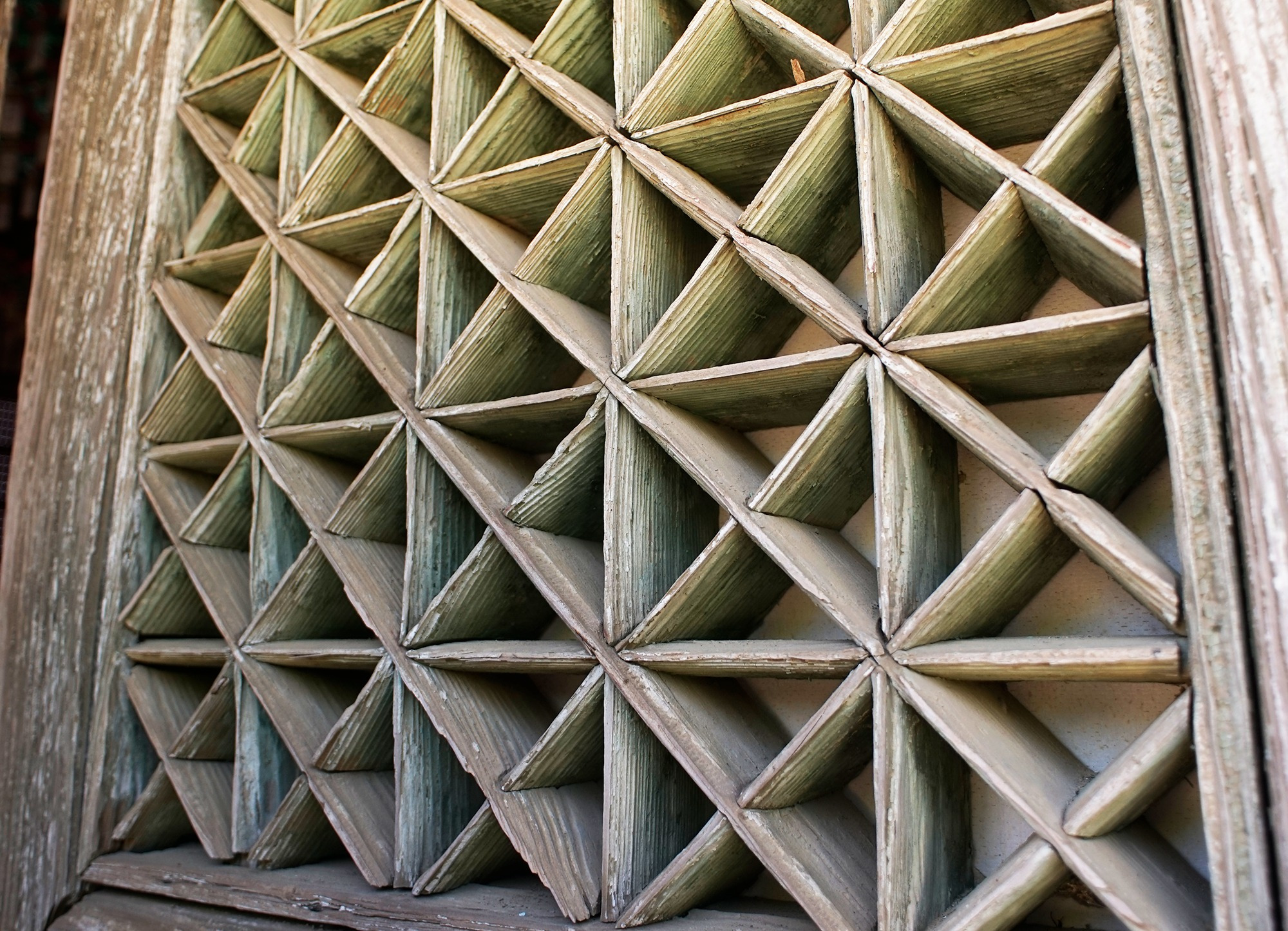
A changho with no paper at all — just lattice rods set directly into the frame.
It was set above a kitchen hearth to vent smoke.
The frame is built long and horizontal, with the rods set in vertically. Later on, the rods' cross-section was cut into triangles, squares, hexagons, or octagons.
This is a name that belongs right alongside bongchang.
Neither carries paper. Both were used in kitchens or storage sheds. There's exactly one difference: whether there are lattice rods, or just a bare hole in the wall.
Jang Gi-in lists the name alone, with no explanation.
Gwangchang (光窓)
Used in two senses.
① A fixed changho cut in to let in light.
It doesn't open. It was set into spots used for storage, like an attic or a storeroom.
In a north-facing room, or a room too large for enough light to reach, a gwangchang was set low and a deulchang built above the middle rail.
② A changho whose lattice is woven into the shape of 井 (jeong).
Also called jeongja-gwangchang. It uses thin, wide slats. The slat's outer face is sometimes rounded off or carved into various shapes. The frame is joined with a mitered or a through joint.
Examples survive at the Palsangjeon Hall of Beopjusa Temple, the Gakhwangjeon Hall and Daeungjeon Hall of Hwaeomsa Temple, Chunghyodang and Imcheonggak in Andong, and Yeongyeongdang at Changdeokgung Palace.
① is a name for a location and a use. ② is a name for a lattice joinery. They belong to different levels of classification.
Deulchang
A small changho set high on a wall. Hinges are set on the top rail, and it opens by lifting the bottom.
The door panel is hung lying on its side, with the hinges at the top. Once lifted, it's held open by a prop.
In a servants' wing, one would be built facing outward so a servant could check who was outside the main gate. They were also placed in the wing quarters of the inner house.
The name refers to both the changho itself and the way it opens.
Mangchang (望窓)
A small changho set high on a wall. Used as another name for deulchang.
"Mang" (望) means to look out. A changho cut high on the wall of a pavilion, positioned for a good view, was called this.
Gochang (高窓)
A low, narrow changho set above a door. Used for ventilation and light.
Its width usually matches the full width of the door frame below it. If it runs too long, it's split into two or three sections. Hinges are set at the top with a hook latch at the bottom, or it's simply fixed in place.
There's a common practice of using it interchangeably with "gyosalchang."
That's because a gochang's lattice was very often built as gyo-sal.
Jang Gi-in notes this common usage too — and states directly that he himself won't use it that way, and will draw a strict line between the two.
Gochang names a location. Gyo-sal names a lattice joinery. They belong to different levels of classification.
Byeorak-dajichang
A changho that opens and closes vertically. Pushed up to open, lowered to close.
Said to be named from the phrase "closes like a bolt of lightning" (byeorak).
Many sources use it as another name for deulchang.
Jang Gi-in, however, places the two in separate entries. He groups byeorak-dajichang with naeri-dajichang, describing it as a changho pushed up to open and lowered to close.
He draws a line between a changho pushed up from the bottom and a changho that simply travels up and down.
A Name I Still Haven't Filled In
Jang-gwangchang (長光窓)
This appears by name alone in Jang Gi-in's classification table, with no explanation in the body text. I haven't found it in other sources either.
Source
- Jang Gi-in, Changho (Korean Architecture Compendium I), Boseonggak, first edition 1983, reprint 2019
- Encyclopedia of Korean Culture, entries "bongchang," "gwangchang"
- Korea Heritage Service, "Borrowed Scenery in Hanok: Changho"
- National Institute of Korean Language, Urimalsaem
Browse the pattern designs in Pyeongmok Studio
Go to the Collection